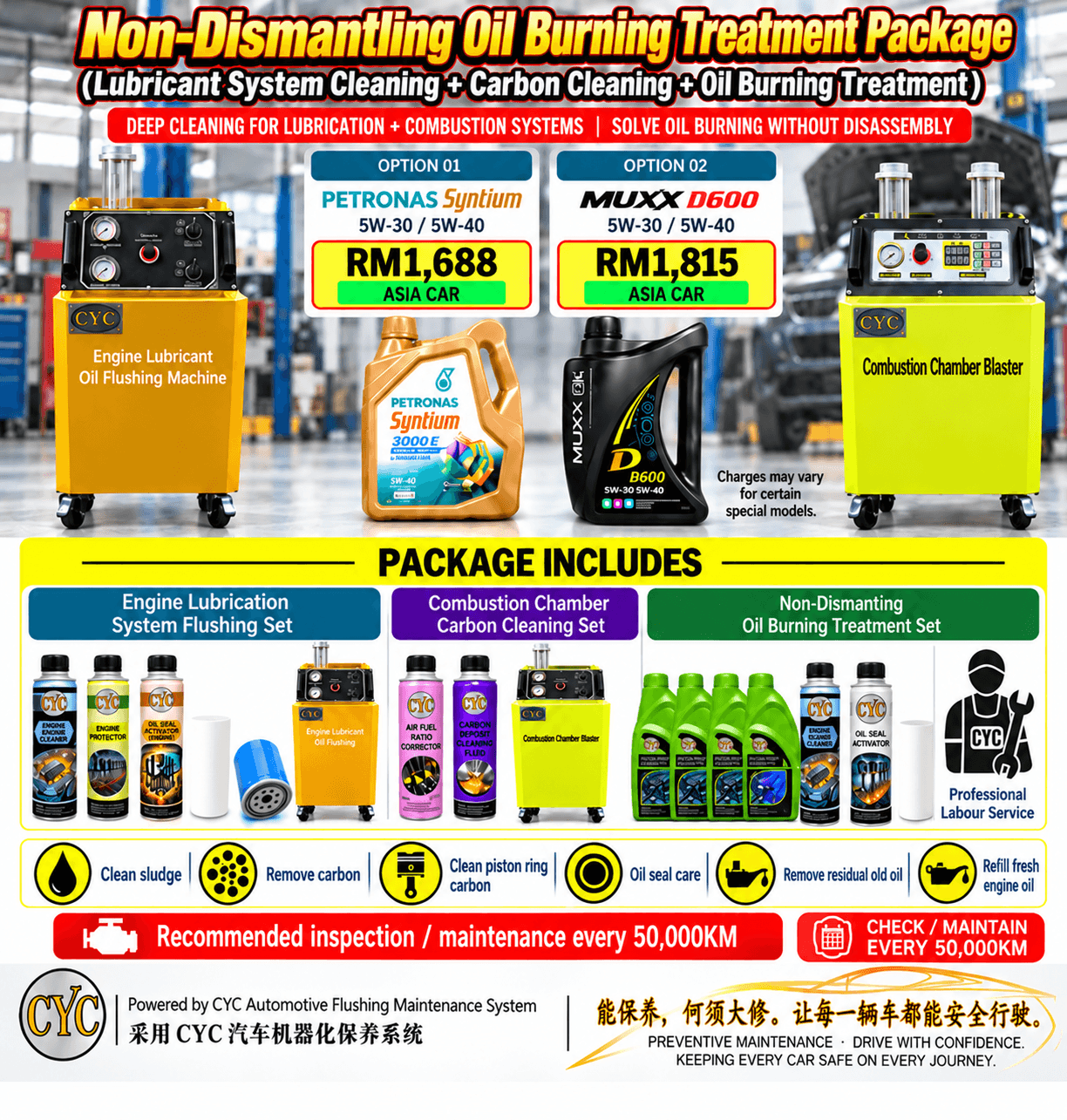
Combustion Chamber Decarbonization + Engine Lubrication System Flushing + Piston Ring Deep Cleaning
Not just about reducing engine oil consumption — it’s also about addressing severe carbon deposits, stubborn engine sludge, and piston ring deposits before they lead to further problems.
Is your car consuming engine oil faster than usual? Has an inspection revealed heavy carbon buildup, excessive engine sludge, or even minor scratches on the cylinder walls?
Many car owners believe that oil burning treatment is only necessary when their engine has already developed serious oil consumption problems.
However, CYC’s Non-Dismantling Oil Burning Treatment can serve two purposes: advanced preventive maintenance and targeted treatment for suitable oil-burning conditions.
By combining professional mechanized cleaning equipment, Piston Ring Flush, and specialized maintenance products, CYC helps remove carbon deposits, sludge, and contaminants from the combustion chamber, piston rings, ring grooves, and engine lubrication system.
For engines experiencing abnormal oil consumption due to carbon-stuck piston rings, appropriate cleaning may help improve oil control and reduce excessive oil consumption.
For engines that are not yet burning oil but already have severe carbon buildup, thick sludge, or suspected piston ring deposits, this package may also be considered as preventive deep cleaning following a proper inspection.
Already burning oil? Identify the cause and treat it early.
Not burning oil yet? Consider preventive maintenance before deposits become more serious.
Preventive Maintenance First. Major Repairs When Necessary.
01|What Is Engine Oil Burning?
Why does engine oil enter the combustion chamber and get burned?
Engine oil lubricates the moving metal components inside your engine, helping reduce friction, wear, and excessive heat.
Inside the engine, pistons move up and down within the cylinders.
Each piston is fitted with piston rings. One of these, the Oil Control Ring, helps regulate the amount of oil on the cylinder wall by removing excess oil while maintaining a thin lubricating film.
When excess engine oil is not properly controlled, some of it may enter the combustion chamber and burn together with the air-fuel mixture.
This is commonly known as engine oil burning or excessive engine oil consumption.
What are the common symptoms?
Engine oil level drops faster than usual
Frequent engine oil top-ups are required
Oil level becomes low before the next scheduled oil change
Blue exhaust smoke may appear in some cases
Spark plugs may become contaminated with engine oil
Carbon deposits may increase inside the combustion chamber
Severe cases may affect engine operation
However, a dropping engine oil level does not always mean the engine is burning oil. External oil leaks can also cause oil loss and should be checked.
What causes engine oil burning?
1. Carbon-Stuck Piston Rings
Carbon deposits and sludge accumulate around the piston rings and ring grooves, restricting normal ring movement and affecting oil control.
2. Worn Piston Rings or Cylinder Walls
Mechanical wear may reduce sealing efficiency and affect the engine’s ability to control oil consumption.
3. Worn Valve Stem Seals
Engine oil may enter the combustion chamber through the valve stem area.
4. PCV System Problems
A faulty Positive Crankcase Ventilation system may allow excessive oil to enter the intake system and combustion chamber.
Not every oil-burning engine requires an immediate overhaul, but not every oil-burning problem can be solved through cleaning.
At CYC, we assess the vehicle’s condition before recommending a suitable treatment.
02|What Is Non-Dismantling Oil Burning Treatment?
Deep engine cleaning without a complete engine overhaul
When car owners hear that their engine is burning oil, they often worry:
“Do I need to dismantle the whole engine?”
“Does my engine need an overhaul?”
“Will the repair cost be very expensive?”
In some engines, excessive oil consumption may be related to carbon deposits restricting the normal movement of piston rings.
For suitable engines, CYC uses professional cleaning equipment and specialized treatment products to address carbon deposits, sludge, and related contaminants without completely dismantling the engine’s major internal mechanical components.
CYC focuses on three important areas
1. Combustion Chamber
Helps remove carbon deposits from the combustion chamber and piston crown.
2. Engine Lubrication System
Uses mechanized oil circulation and precision filtration to help reduce engine sludge and contaminants.
3. Piston Rings & Ring Grooves
Uses Piston Ring Flush together with machine-assisted circulation cleaning to help soften and remove accessible deposits around the piston rings and ring grooves, while also targeting thick, sticky engine sludge.
The process is completed with the removal of residual used engine oil, followed by fresh engine oil and a new oil filter.
More than cleaning a single component — CYC provides a comprehensive cleaning and maintenance process for the combustion chamber, lubrication system, and piston ring area.
03|Why Do Piston Rings Affect Engine Oil Consumption?
Piston rings play an important role in controlling engine oil
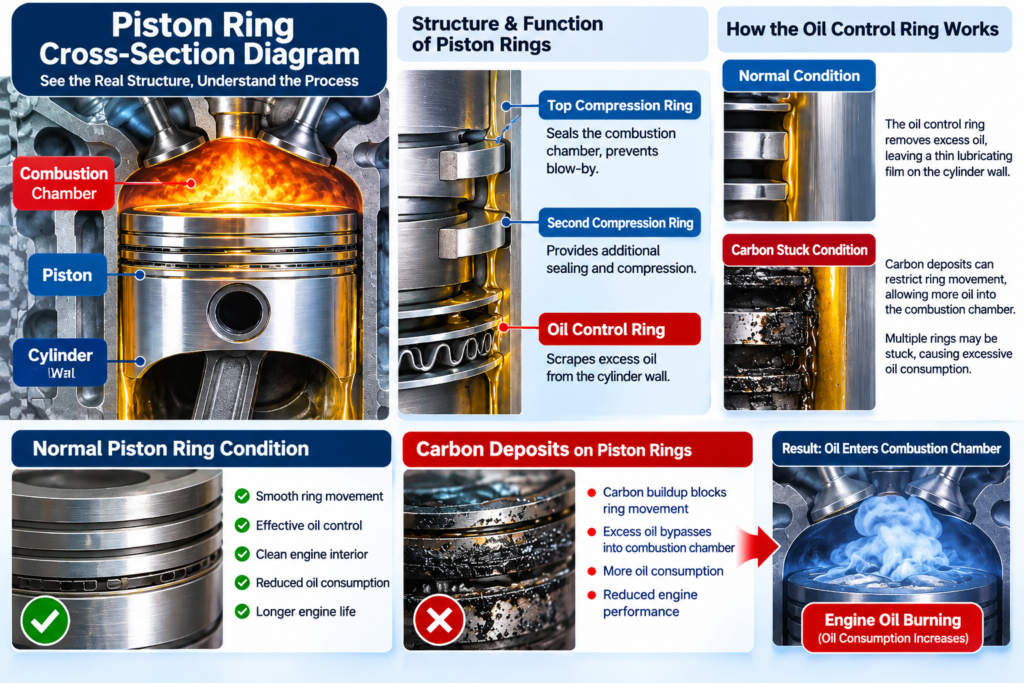
Piston rings help seal the combustion chamber, regulate engine oil, and transfer heat from the piston to the cylinder wall.
The Oil Control Ring is especially important because it removes excess oil from the cylinder wall during piston movement.
Under normal operating conditions, a thin oil film remains on the cylinder wall to lubricate the moving components.
What happens when piston rings become stuck with carbon?
Over time, carbon deposits and contaminants may accumulate around the piston rings and inside the ring grooves.
As these deposits build up, they may restrict normal piston ring movement.
When the Oil Control Ring cannot function properly, excess engine oil may remain on the cylinder wall.
Some of this oil may enter the combustion chamber and burn.
The result?
Engine oil consumption may increase, and the owner may need to top up engine oil more frequently.
How does Piston Ring Flush help?
CYC uses professional Piston Ring Flush together with mechanized engine oil circulation cleaning to help soften and clean accessible carbon deposits and contaminants around the piston rings and ring grooves.
Its main purposes include:
Helping reduce carbon deposits around piston rings
Helping improve piston ring movement affected by carbon buildup
Supporting proper oil control where deposits are the contributing factor
Providing additional cleaning for thick, sticky engine sludge through machine-assisted circulation
Supporting a cleaner lubrication environment when followed by proper engine oil replacement
If excessive oil consumption is mainly caused by carbon-stuck piston rings, appropriate cleaning may help improve oil control and reduce oil consumption.
Piston Ring Flush cannot repair severely worn piston rings or damaged cylinder walls.
04|Can This Package Be Used Before an Engine Starts Burning Oil?
Yes. Advanced preventive maintenance is also an important purpose of this package.
Some car owners may ask:
“My car is not burning engine oil. Why would I need an oil burning treatment?”
At CYC, preventive maintenance means identifying and addressing potential problems before they develop into more serious conditions.
This package may be considered when an inspection reveals significant carbon deposits, sludge, or suspected piston ring contamination.
When should you consider further inspection?
1. Severe Combustion Chamber Carbon Buildup
Heavy carbon deposits are visible on the piston crown or inside the combustion chamber.
2. Excessive Engine Sludge
Thick sludge has accumulated inside the engine and may affect the cleanliness of the lubrication system.
3. Suspected Piston Ring Deposits
Carbon and contaminants may be restricting normal piston ring movement.
4. Minor Cylinder Wall Scratches Detected During Inspection
Further assessment is needed to determine the extent of wear and whether cleaning is suitable.
5. Preventive Piston Ring Deep Cleaning
For engines with confirmed deposit-related concerns, a more comprehensive cleaning procedure may be considered.
Why consider preventive deep cleaning?
Long-term accumulation of carbon and sludge may affect piston ring movement, oil control, and the engine’s lubrication environment.
Appropriate inspection and cleaning may help reduce the impact of these deposits.
Already burning oil? Focus on identifying and treating suitable deposit-related causes.
Not burning oil yet? Consider preventive cleaning when significant deposits are detected.
Preventive cleaning cannot guarantee that oil burning or mechanical wear will never occur. It also cannot repair existing scratches or worn metal components.
05|Why Is Combustion Chamber Decarbonization Important?
Combustion Chamber Decarbonization
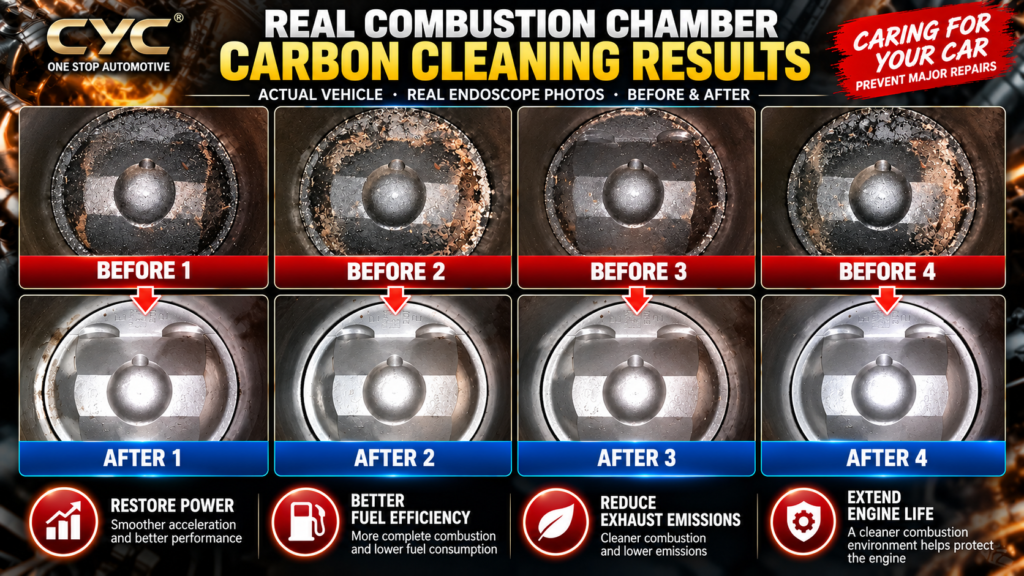
The combustion chamber is where the air-fuel mixture burns to produce the energy that drives the piston.
Over time, combustion by-products may form carbon deposits on the piston crown and inside the combustion chamber.
Excessive carbon buildup may affect combustion conditions and contribute to symptoms such as:
Rough idling
Sluggish throttle response
Reduced engine performance
Increased fuel consumption
How does CYC clean the combustion chamber?
CYC uses a professional Combustion Chamber Blaster, together with Carbon Deposit Treatment Fluid, to help soften and remove carbon deposits from the combustion chamber and piston crown.
For accessible inspection areas, actual before-and-after borescope images can be used to show visible cleaning results.
The purpose is not simply to make the piston crown look cleaner, but to help reduce carbon deposits in the combustion area.
06|Why Is Engine Lubrication System Flushing Necessary?
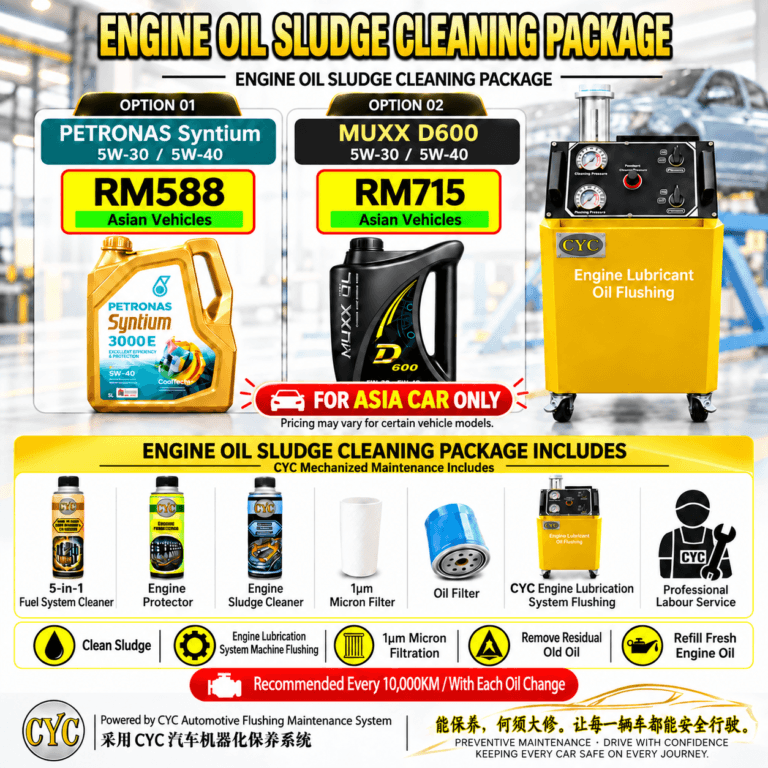
Engine Lubricant Oil Flushing
An engine can contain both carbon deposits and sludge
Combustion chamber carbon deposits and engine sludge are different types of contamination.
Carbon deposits commonly develop in the combustion area.
Engine sludge may accumulate within the lubrication system, oil pan, and other internal engine areas.
During combustion chamber and piston ring cleaning, some cleaning fluid and loosened contaminants may pass into the crankcase and mix with the existing engine oil.
This is why CYC includes mechanized engine lubrication system flushing as part of the comprehensive treatment.
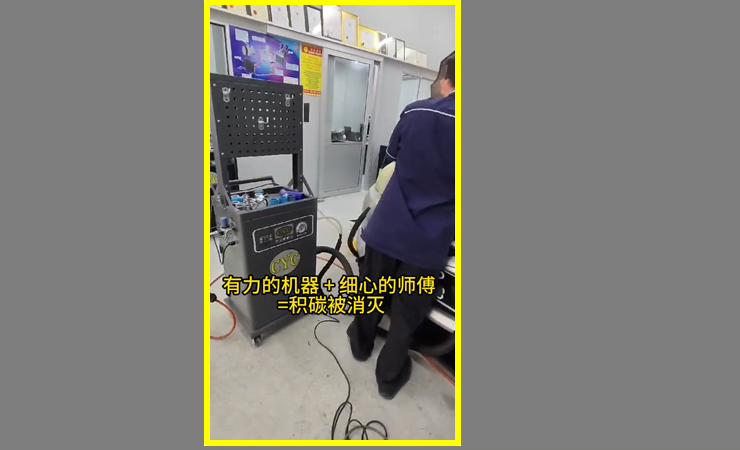
CYC Engine Lubricant Oil Flushing Machine
CYC’s professional flushing machine connects to the engine’s oil filter mounting location through a suitable adapter.
The engine’s own oil pump drives oil circulation through the connected cleaning and filtration system.
Together with specialized cleaning products and a 1μm Micron Filter, the process helps reduce sludge, deposits, and contaminants circulating in the lubrication system.
How is this different from a regular engine oil change?
A regular oil change mainly involves draining used engine oil and replacing it with fresh oil.
However, sludge and deposits attached to internal engine surfaces may not be fully removed through conventional oil draining alone.
CYC’s mechanized circulation cleaning and precision filtration provide an additional process for reducing contaminants within the lubrication system.
It’s not just about changing engine oil — it’s also about maintaining a cleaner engine lubrication system.
07|How Can Piston Ring Flush Help With Thick Engine Sludge?
Piston Ring Flush + Machine Circulation Cleaning
More than piston ring cleaning — additional treatment for stubborn, sticky engine sludge
This is one of the key differences between CYC’s comprehensive treatment and conventional combustion chamber cleaning.
After the initial engine lubrication system flushing stage, CYC uses Piston Ring Flush together with the professional circulation cleaning machine for an additional deep-cleaning process.
Besides targeting deposits around the piston rings and ring grooves, Piston Ring Flush is also used to help soften and clean thick, sticky sludge within suitable areas of the engine.
Why does CYC use a multi-stage cleaning process?
Not all engine deposits are equally easy to remove.
Ordinary sludge and long-standing, thick, sticky deposits may require different cleaning approaches.
Stage 1 — Initial Lubrication System Flushing
Helps reduce existing sludge and contaminants in the lubrication system.
Stage 2 — Piston Ring Flush with Machine Circulation
Provides additional cleaning for accessible piston ring deposits and stubborn engine sludge.
Stage 3 — Final Oil Drain and Replacement
Helps remove residual used oil and related contaminants before filling the engine with fresh oil.
The purpose is to improve the cleanliness of the engine’s internal lubrication environment.
Engines with heavily solidified sludge, abnormal oil pressure, or suspected oil passage blockage must be assessed before flushing, as mechanical cleaning or repair may be required.
08|CYC Complete Treatment Procedure
Three Major Cleaning & Treatment Stages
Stage 1|Combustion Chamber Decarbonization
Combustion Chamber Blaster + Carbon Deposit Treatment Fluid
CYC uses a professional Combustion Chamber Blaster and specialized carbon treatment fluid to help soften and remove deposits from the combustion chamber and piston crown.
Main purpose: Reduce combustion chamber carbon deposits.
Stage 2|Engine Lubrication System Flushing
Engine Lubricant Oil Flushing
A professional flushing machine is connected to the engine’s oil filter mounting location using a suitable adapter.
The engine’s original oil pump drives oil circulation through the cleaning and filtration system.
Specialized cleaning products and 1-micron precision filtration help reduce sludge and contaminants.
Main purpose: Perform initial lubrication system cleaning before the next deep-cleaning stage.
Stage 3|Piston Ring Deep Cleaning & Stubborn Sludge Treatment
Piston Ring Flush + Machine Circulation Cleaning + Oil Seal Activator
CYC uses Piston Ring Flush together with the engine lubrication system flushing machine.
This additional process helps soften and clean accessible deposits around the piston rings and ring grooves while providing further treatment for thick, sticky engine sludge.
An appropriate Oil Seal Activator is also used as part of the oil seal maintenance process.
Main purpose: Provide additional cleaning for piston ring deposits and stubborn sludge as part of advanced preventive maintenance or targeted treatment.
Oil seal maintenance products cannot repair torn, severely damaged, or mechanically failed oil seals.
Final Stage|Residual Oil Drain & Fresh Engine Oil Replacement
Final Oil Drain & Engine Oil Replacement
After completing the cleaning procedures, residual used engine oil and related contaminants are further drained.
For vehicles equipped with a steel oil pan, CYC’s service procedure requires oil pan removal and internal cleaning.
The process is completed by replacing the engine oil and oil filter with new products that meet the vehicle’s requirements.
Complete CYC Treatment Sequence
Combustion Chamber Decarbonization → Engine Lubrication System Flushing → Piston Ring Flush with Machine Circulation → Oil Seal Maintenance → Final Oil Drain → Fresh Engine Oil & Oil Filter Replacement
Not just about reducing oil consumption — it’s a comprehensive approach to severe carbon deposits, stubborn sludge, and piston ring maintenance.
09|Why Does a Steel Oil Pan Require Removal and Cleaning?
Steel Oil Pan Removal & Cleaning
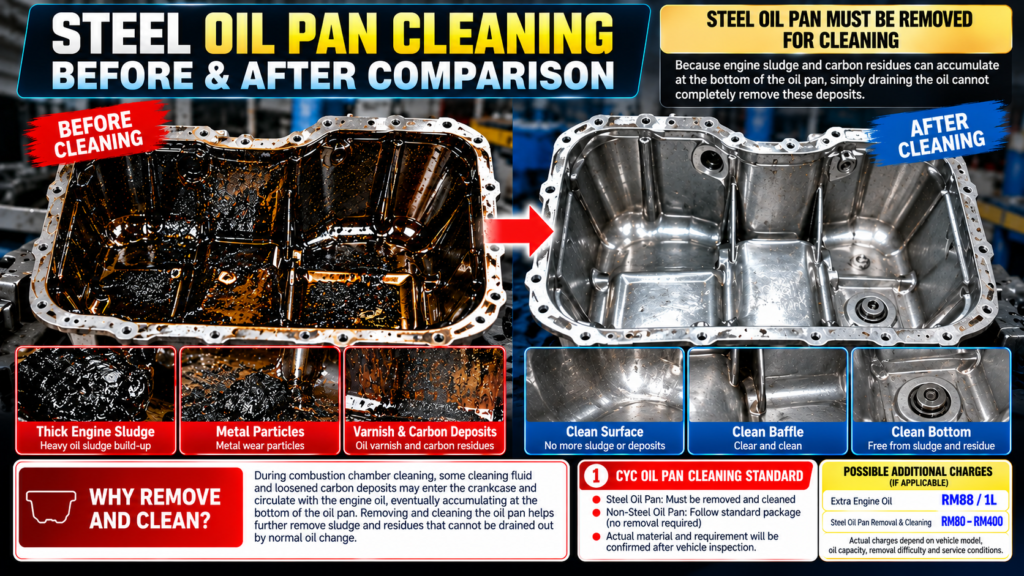
The engine oil pan is located at the bottom of the engine and collects the oil returning from the lubrication system.
Over time, sludge and contaminants may accumulate at the bottom of the oil pan.
In engines with heavy sludge buildup, conventional oil draining may not sufficiently remove thick deposits attached to the internal surfaces.
CYC Oil Pan Cleaning Standard
Steel Oil Pan
Under CYC’s service procedure, a steel oil pan must be removed and internally cleaned to address sludge and contaminants accumulated at the bottom.
Non-Steel Oil Pan
Under CYC’s current package procedure, additional oil pan removal is generally not required.
The actual oil pan material, design, and service requirements will be confirmed during vehicle inspection.
Possible Additional Charges
Additional Item | Price |
|---|---|
| Extra Engine Oil | RM88 / 1L |
| Steel Oil Pan Removal & Cleaning | RM80–RM400 |
Actual charges depend on the vehicle model, engine oil capacity, and removal complexity. Any additional work will be explained and quoted before proceeding.
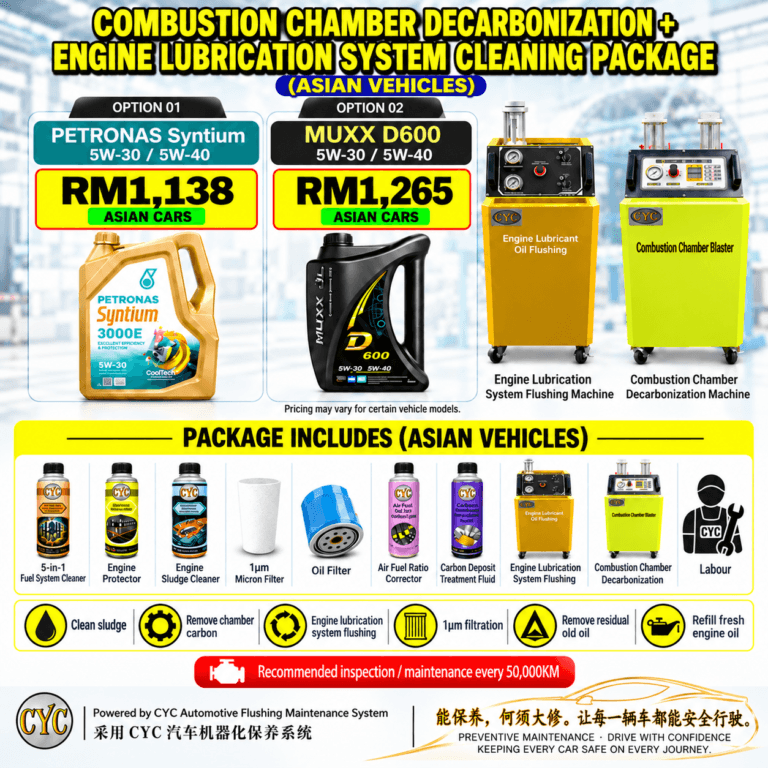
10|CYC Non-Dismantling Oil Burning Treatment Package Price
Asian Vehicles
OPTION 01|PETRONAS Syntium
RM1,688
5W-30 / 5W-40
OPTION 02|MUXX D600
RM1,815
5W-30 / 5W-40
Main Services Included
Combustion Chamber Decarbonization
Engine Lubrication System Flushing
Piston Ring Flush & Ring Groove Deep Cleaning
Additional Cleaning for Stubborn Engine Sludge
Oil Seal Activator Maintenance
1-Micron Precision Filtration
Residual Used Oil Removal
Fresh Engine Oil & Oil Filter Replacement
Professional Labour Service
Package Price Conditions
The above prices apply to eligible Asian vehicles under the standard package conditions. They are not fixed prices for every Asian vehicle.
Additional quotation may be required for:
6-cylinder engines
V6 / V8 engines
Special engine designs
Vehicles requiring additional engine oil
Vehicles requiring special adapters or additional dismantling work
Vehicles requiring steel oil pan removal and cleaning
The engine oil viscosity and specification must meet the vehicle manufacturer’s requirements.
11|What Does the Package Include?
Package Includes
Item | Description |
|---|---|
| Engine Oil | PETRONAS Syntium or MUXX D600 |
| Engine Oil Filter | New engine oil filter |
| Engine Sludge Cleaner | Engine sludge cleaning product |
| Engine Protector | Engine protection additive |
| 5-in-1 Fuel System Cleaner | Multi-purpose fuel system cleaning product |
| 1μm Micron Filter | 1-micron precision filter |
| Air Fuel Ratio Corrector | Air-fuel ratio treatment product |
| Carbon Deposit Treatment Fluid | Combustion chamber carbon treatment fluid |
| Piston Ring Flush | Piston ring and ring groove cleaning treatment |
| Oil Seal Activator | Oil seal maintenance treatment |
| Engine Lubricant Oil Flushing | Mechanized engine lubrication system flushing |
| Combustion Chamber Decarbonization | Machine-assisted combustion chamber cleaning |
| Professional Labour Service | Professional service and labour |
Extra engine oil, steel oil pan removal and cleaning, and additional work required for special engine designs are not included in the standard package price. Actual product application and service procedures depend on vehicle compatibility and the confirmed package.
12|Before & After Results — See the Difference
Before & After Comparison · Transparent Service Records
We don’t just explain the cleaning process — we help you see the actual results
At CYC, transparency and service documentation are important parts of our maintenance approach.
Where applicable, we provide actual before-and-after photos to help customers understand the condition of carbon deposits, sludge, and contaminants before cleaning and the visible changes after treatment.
Examples include:
Combustion chamber and piston crown before-and-after images
Engine lubrication system cleaning records
Oil pan cleaning comparisons for applicable vehicles
Other accessible areas where cleaning results can be documented
If additional repairs or component replacements are carried out, relevant service records may also be provided.
Inspection · Clear Explanation · Transparent Quotation · Service Documentation
See the condition. Understand the process. Make an informed decision.
Images depend on the actual services performed and the areas accessible for inspection. Visible cleaning results do not mean that mechanical wear has been repaired.
13|When Should This Maintenance Be Considered?
Recommended Inspection & Maintenance Interval
Non-Dismantling Oil Burning Treatment
Recommended inspection every 50,000 KM, with treatment based on actual engine condition.
Vehicles with severe carbon deposits, excessive sludge, or suspected piston ring deposits may benefit from further assessment for advanced cleaning.
If the vehicle already has excessive oil consumption, the cause should be investigated before selecting the treatment.
Combustion Chamber Decarbonization + Engine Lubrication System Flushing
Recommended inspection every 50,000 KM, with maintenance performed as required.
Engine Lubrication System Flushing
CYC recommends assessment every 10,000 KM or during scheduled engine oil servicing.
For suitable engines in normal operating condition, lubrication system cleaning may be considered as part of a preventive maintenance plan.
Not every engine oil change requires a complete Non-Dismantling Oil Burning Treatment.
However, if an inspection reveals severe carbon buildup, sludge, or suspected piston ring deposits, advanced cleaning may be worth considering.
These are CYC preventive maintenance recommendations and are not universal manufacturer-specified service intervals.
14|Frequently Asked Questions (FAQ)
Q1: What exactly is Non-Dismantling Oil Burning Treatment?
Simply put, it is a comprehensive engine cleaning and maintenance process that addresses combustion chamber carbon deposits, piston ring deposits, and engine sludge without completely dismantling the engine.
The goal is to reduce deposits, help improve piston ring movement affected by carbon buildup, and potentially improve excessive oil consumption in suitable engines.
Q2: My car is already burning engine oil. Can this treatment help reduce it?
If excessive oil consumption is mainly caused by carbon-stuck piston rings, appropriate cleaning may help improve oil control and reduce oil consumption.
However, if the main cause is severe piston ring wear, cylinder wall damage, or another mechanical fault, the affected components may require repair.
CYC recommends checking the cause before choosing a treatment.
Q3: My car is not burning oil. Why should I consider this package?
This package is not only intended for engines with existing oil-burning symptoms.
It can also serve as advanced preventive maintenance for suitable engines with significant carbon buildup, sludge, or suspected piston ring deposits.
You don’t have to wait until your engine starts consuming excessive oil before paying attention to piston ring and lubrication system maintenance.
Q4: Can this treatment be performed if cylinder wall scratches are found?
It depends on the severity of the scratches and the overall engine condition.
If carbon deposits or piston ring contamination are also present, CYC can assess whether cleaning is appropriate.
However, cleaning cannot repair existing cylinder wall scratches or replace mechanical repairs required for severe wear.
Q5: How is Piston Ring Flush different from regular carbon cleaning?
Regular combustion chamber decarbonization mainly focuses on the combustion chamber and piston crown.
Piston Ring Flush provides additional treatment for deposits around the piston rings and ring grooves.
When combined with mechanized oil circulation cleaning, it can also help soften and clean thick, sticky engine sludge.
It’s not just about cleaning the combustion chamber — it’s also about maintaining the piston ring area and lubrication system.
Q6: Does non-dismantling mean absolutely no parts need to be removed?
No.
Non-dismantling means the engine does not need to be completely taken apart as it would during a traditional engine overhaul.
Depending on the vehicle, spark plugs, related accessories, or other necessary components may still need to be removed.
For vehicles with a steel oil pan, CYC’s procedure also requires oil pan removal and internal cleaning.
The advantage is avoiding a complete engine overhaul-style dismantling, while allowing the necessary minor component removal to complete the treatment.
Q7: How can I tell whether the treatment has worked?
For combustion chamber cleaning, visible changes can be compared using actual before-and-after borescope images.
If the vehicle was previously experiencing excessive oil consumption, improvement should be evaluated by monitoring engine oil level, oil top-up quantity, and distance travelled.
Cleaning results can be shown through photos. Changes in engine oil consumption should be assessed through actual driving records.
Q8: Will one treatment guarantee that my engine never burns oil again?
The treatment focuses on carbon deposits, engine sludge, and piston ring deposits that are suitable for cleaning.
Proper inspection and maintenance may help reduce the effects of these contaminants, but they cannot guarantee that mechanical wear or oil-burning problems will never develop.
CYC focuses on early inspection and appropriate maintenance instead of waiting for serious engine damage.
Q9: Why is fresh engine oil required after cleaning?
Some cleaning fluids and loosened contaminants may enter the crankcase and mix with the existing engine oil.
Therefore, CYC includes mechanized lubrication system flushing, precision filtration, residual used oil removal, and fresh engine oil and filter replacement as part of the process.
Cleaning the deposits is important — but completing the proper lubrication system maintenance afterwards is just as important.
Q10: Is this treatment suitable for engines with severe mechanical wear?
The engine condition must be assessed first.
If the problem is mainly related to carbon deposits and sludge, appropriate cleaning may be considered.
If severe cylinder wall damage, piston ring wear, or other mechanical faults are found, further repair may be necessary.
When maintenance is appropriate, maintain it properly. When repairs are necessary, address the actual mechanical problem.
That is why CYC believes in inspecting first and recommending the right solution.
15|Free Comprehensive Vehicle Inspection
Inspect First. Recommend Accordingly.
CYC provides a free comprehensive vehicle inspection covering nine major systems:
Engine System
Automatic Transmission & ATF Condition
Engine Cooling System
Air Conditioning System
Tyre Condition
Brake System
Chassis & Suspension System
Computer Diagnostics
Battery & Charging System
After the inspection, our team will explain the findings, recommend suitable maintenance where necessary, and provide a transparent quotation.
Customers can then decide whether to proceed with the recommended services.
Estimated inspection time: Approximately 1 hour, depending on vehicle condition.
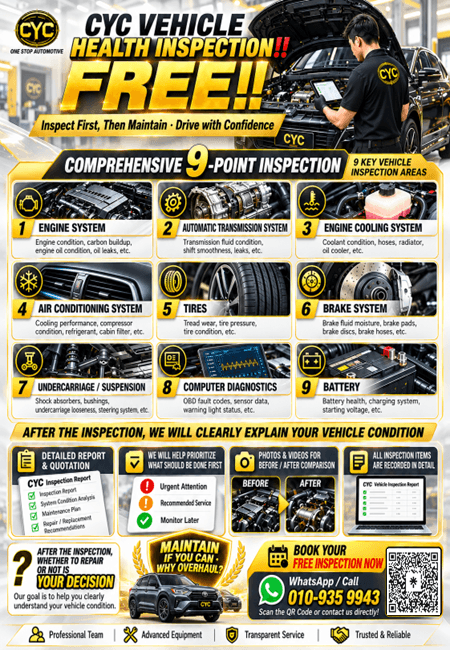
The free comprehensive inspection does not include every specialized test required to diagnose the cause of engine oil burning. Additional diagnostic tests, if necessary, will be explained separately.
16|Flexible Payment Options
CYC offers several convenient payment methods:
0% Credit Card Instalment: Eligible transactions of RM500 and above, with 6-month or 12-month instalment options
Credit Card
Shopee / Grab PayLater (subject to eligibility)
ShopeePay
GrabPay
Touch ‘n Go eWallet
Cash
Bank Transfer
Instalment and PayLater arrangements are subject to the applicable provider’s terms and CYC’s payment conditions.

17|Book Your Non-Dismantling Oil Burning Treatment
Is your engine consuming excessive oil, or has an inspection revealed severe carbon deposits or sludge?
Don’t wait for the problem to become more serious before getting your engine checked.
Whether your vehicle is experiencing increased engine oil consumption, severe combustion chamber carbon buildup, excessive sludge, or you simply want to understand preventive piston ring maintenance, CYC can help assess the next step.
Please provide the following vehicle details:
Vehicle Make & Model
Manufacturing Year
Engine Capacity (CC)
Current Mileage (KM)
Petrol / Diesel / Hybrid
Any symptoms such as excessive engine oil consumption, rough idling, reduced performance, or other concerns
Our team will review the vehicle information, engine design, and reported condition to determine whether the treatment is suitable and provide the appropriate package recommendation and quotation.
WhatsApp: 010-935 9943
WhatsApp Us for Enquiries & Appointments
CYC ONE STOP AUTOMOTIVE SDN. BHD.
Carbon Deposit Cleaning · Engine Sludge Removal · Piston Ring Deep Cleaning · Preventive Maintenance & Targeted Treatment
Already burning oil? Identify the cause early.
Not burning oil yet? Consider appropriate preventive maintenance.
Preventive Maintenance First. Major Repairs When Necessary.
Caring For Your Car.