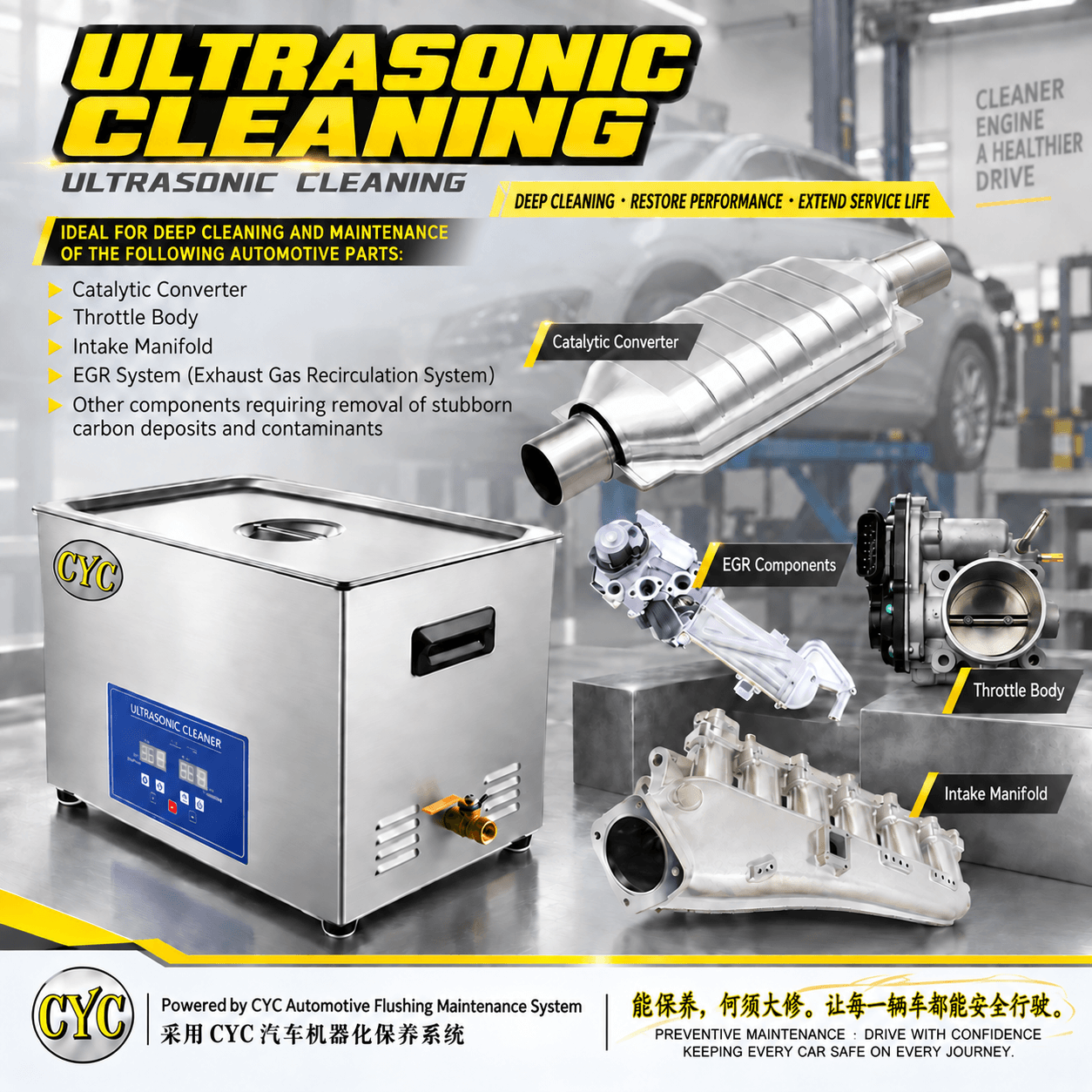
Automotive Ultrasonic Deep Cleaning Service
Professional Ultrasonic Cleaning for Automotive Components
Does Heavy Carbon Buildup Mean Automotive Parts Must Be Replaced?
As vehicles accumulate mileage, carbon deposits, oil residue, and other contaminants may gradually build up inside engine intake and exhaust system components.
Components such as the Catalytic Converter, Throttle Body, Intake Manifold, and EGR System often have complex internal structures. Some areas are so narrow that conventional brushes cannot reach them effectively.
As these deposits accumulate, they may restrict airflow, affect exhaust flow, and interfere with the normal operation of certain components.
A Dirty Component Does Not Necessarily Mean a Damaged Component.
If a component is mainly affected by carbon deposits or oil contamination, while its structure and functionality remain intact, professional deep cleaning may be a suitable option before considering replacement.
At CYC, we use professional ultrasonic cleaning equipment that combines water and high-frequency sound waves to help remove carbon deposits, oil residue, and other contaminants from suitable automotive components.
Why Replace When Proper Maintenance May Be Enough?
What Is Ultrasonic Cleaning?
Understanding Ultrasonic Cleaning Technology
Ultrasonic cleaning is a professional cleaning method that uses high-frequency sound waves travelling through water to clean automotive components.
When ultrasonic waves pass through water, they generate countless microscopic bubbles that are invisible to the naked eye.
These tiny bubbles rapidly form and collapse, creating small but concentrated forces that help loosen, break up, and separate carbon deposits, oil residue, and other contaminants from component surfaces.
This process is technically known as Cavitation.
In simple terms:
Conventional manual cleaning relies on brushes or tools making direct contact with dirt. Ultrasonic cleaning uses the repeated formation and collapse of tiny bubbles in water to help lift contaminants away from component surfaces.
Where water can reach, including narrow gaps, small openings, and certain complex internal passages, ultrasonic cleaning can help remove contaminants that are difficult to reach manually.
CYC’s ultrasonic cleaning equipment uses ordinary water as the cleaning medium. No additional chemical cleaning agents are required for the ultrasonic cleaning action to take place.
Unlike steel brushes or scrapers, ultrasonic cleaning does not rely on direct mechanical scraping, helping reduce the risk of surface damage associated with aggressive manual cleaning.
It Goes Beyond Cleaning Visible Surfaces — Helping Reach Areas That Conventional Brushes Cannot Easily Access.
Cleaning results depend on the component material, internal structure, type of contamination, and cleaning conditions. Components must be assessed for ultrasonic cleaning suitability before treatment.
Key Features of CYC Ultrasonic Cleaning
1. Water and Sound Waves Work Together to Loosen Stubborn Deposits
High-frequency ultrasonic waves travel through water, generating countless microscopic bubbles.
As these bubbles repeatedly form and collapse, they help loosen carbon deposits, oil residue, and other contaminants attached to component surfaces.
2. Reaches Narrow Gaps and Complex Internal Structures
Conventional cleaning methods are limited by the size of brushes and the shape of components.
Ultrasonic cleaning can work in areas accessible to water, helping clean certain narrow openings, small gaps, and complicated internal passages.
3. Reduces the Need for Direct Surface Scraping
Traditional manual cleaning may involve brushes or scrapers to remove stubborn deposits.
Ultrasonic cleaning primarily relies on the action of microscopic bubbles in water, reducing the need for direct mechanical scraping in suitable applications.
4. Effective Cleaning Action Using Ordinary Water
CYC’s ultrasonic cleaning equipment uses ordinary water as its cleaning medium.
Through the interaction between water and high-frequency sound waves, ultrasonic cleaning can help loosen and remove certain contaminants without relying on additional chemical cleaning agents.
5. Helps Maintain Components That Are Still Serviceable
For components that remain structurally sound and functional but are affected by carbon buildup or oil contamination, professional deep cleaning may be considered before replacement.
This allows vehicle owners to make maintenance decisions based on the actual condition of their components, potentially avoiding unnecessary replacement costs.
Which Automotive Components Can Be Ultrasonically Cleaned?
1. Catalytic Converter
An Essential Component of the Vehicle’s Exhaust System
The catalytic converter helps reduce harmful pollutants in vehicle exhaust gases through chemical reactions.
Over time, some catalytic converters may become contaminated with carbon deposits, oil residue, and other accumulated substances.
Inside a catalytic converter is a dense honeycomb structure containing numerous narrow passages. These passages are difficult to clean using conventional brushes.
Professional ultrasonic cleaning uses water and high-frequency sound waves to help loosen and remove certain contaminants from accessible internal passages and surfaces.
For catalytic converters that are structurally intact and mainly affected by removable deposits, suitable cleaning may help improve exhaust flow where contamination is causing a restriction.
CYC recommends inspecting the catalytic converter every 100,000 KM and assessing whether ultrasonic deep cleaning is necessary.
If the internal honeycomb structure has melted or fractured, or the catalytic material has lost its effectiveness, cleaning cannot repair these conditions. Further assessment or replacement may be required.
2. Throttle Body
An Important Component That Controls Engine Airflow
The throttle body regulates the amount of air entering the engine.
Over time, carbon deposits and oil residue may accumulate around the throttle plate and surrounding surfaces.
If these deposits interfere with throttle movement or airflow control, the vehicle may experience unstable idling or delayed throttle response.
Appropriate cleaning helps remove these deposits and supports normal throttle operation.
CYC recommends inspecting the throttle body every 20,000 KM and performing cleaning when required.
Some electronic throttle bodies are not suitable for direct immersion in an ultrasonic cleaning tank. The appropriate cleaning method must be selected according to the component’s design.
3. Intake Manifold
Distributes Air to the Engine Cylinders
The intake manifold contains internal passages that distribute incoming air to the engine cylinders.
Over time, some engines may develop carbon buildup, oil residue, and other deposits inside these passages.
Excessive buildup may restrict airflow and affect engine operation.
For suitable intake manifolds, ultrasonic cleaning can help remove deposits from certain internal areas that are difficult to reach with conventional cleaning tools.
CYC recommends determining the need for deep cleaning based on vehicle mileage, carbon buildup, and actual inspection findings.
4. EGR System
Exhaust Gas Recirculation System
The EGR system redirects a portion of exhaust gases back into the engine’s intake system to help control combustion temperature and nitrogen oxide emissions.
Because EGR components are regularly exposed to exhaust gases, carbon deposits may gradually accumulate around the valve and internal passages.
Severe carbon buildup may interfere with valve movement or restrict internal passages.
For suitable EGR components, ultrasonic cleaning can help loosen and remove accumulated deposits, supporting normal system operation.
CYC recommends EGR cleaning based on vehicle condition, diagnostic findings, and the severity of carbon buildup.
5. Other Automotive Components
Certain automotive components affected by carbon deposits, oil residue, or other contaminants may also be suitable for ultrasonic cleaning.
Suitability depends on the component’s material, construction, and internal design.
Not every component can be safely immersed in water. Parts containing sensitive electronics, special coatings, or sealed assemblies may require alternative cleaning methods.
CYC Recommended Automotive Component Maintenance Schedule
Component | Recommended Interval | Maintenance Recommendation |
|---|---|---|
| Throttle Body | Every 20,000 KM | Inspect carbon and oil deposits; clean when necessary |
| Catalytic Converter | Every 100,000 KM | Inspect operating condition and contamination; assess whether ultrasonic cleaning is required |
| Intake Manifold | Based on inspection | Clean according to carbon buildup and component condition |
| EGR System | Based on inspection | Clean according to carbon buildup and diagnostic findings |
Inspect First, Recommend Accordingly. Reaching a particular mileage does not automatically mean a component must be removed and cleaned.
The above intervals are CYC’s general preventive maintenance recommendations and are not universal manufacturer-specified service intervals. Actual requirements depend on the vehicle model, component design, and inspection findings.
When Should You Arrange an Inspection?
We recommend arranging a professional inspection if your vehicle experiences any of the following:
Reduced engine power or sluggish acceleration
Unstable engine idling
Check Engine Light illuminated
Visible carbon buildup in the intake system
EGR-related diagnostic trouble codes
Exhaust system abnormalities or suspected catalytic converter blockage
High vehicle mileage with no previous inspection of related components
These symptoms may be associated with carbon buildup, but they can also result from mechanical or electronic faults.
At CYC, we assess the vehicle’s actual condition before recommending an appropriate cleaning, maintenance, or repair solution.
CYC Ultrasonic Cleaning Service Prices
Catalytic Converter Ultrasonic Deep Cleaning
From RM750
The actual price depends on the vehicle model, number of catalytic converters, removal and installation difficulty, and level of contamination.
Ultrasonic Cleaning for Other Automotive Components
Cleaning services for throttle bodies, intake manifolds, EGR components, and other suitable automotive parts are quoted individually.
Pricing depends on:
Vehicle make and model
Type of component requiring cleaning
Component design and removal difficulty
Severity of carbon deposits, oil residue, and other contaminants
Additional parts or related repair work, if required
Please provide your vehicle details so our team can prepare an initial assessment and quotation.
Estimated Service Duration
Service duration varies depending on the vehicle model, component accessibility, removal and installation requirements, and cleaning work involved.
The service typically requires at least 2 days.
Advance booking is recommended to allow sufficient time for inspection, cleaning, and reinstallation.
Frequently Asked Questions (FAQ)
Q1: What Makes Ultrasonic Cleaning Special? How Can It Clean Narrow Gaps?
Ultrasonic cleaning combines water and high-frequency sound waves to perform deep cleaning.
When ultrasonic waves travel through water, they generate countless microscopic bubbles.
These bubbles repeatedly form and collapse, creating tiny forces that help loosen and lift contaminants from component surfaces.
Conventional brushes can only clean areas they can physically reach. Ultrasonic cleaning can help clean narrow gaps and complex passages that water can enter but brushes cannot easily access.
Q2: Why Is Ultrasonic Cleaning Suitable for Catalytic Converters?
Catalytic converters contain dense honeycomb structures with numerous narrow passages that are difficult to reach using conventional manual cleaning.
Ultrasonic waves travel through water and help loosen certain contaminants inside accessible passages.
For catalytic converters with intact internal structures and contamination-related restrictions, ultrasonic cleaning may be a suitable deep-cleaning option after inspection.
Q3: Does Ultrasonic Cleaning Require Chemical Cleaning Agents?
No additional chemical cleaning agents are required for CYC’s water-based ultrasonic cleaning process.
Our ultrasonic equipment uses ordinary water as the cleaning medium.
When ultrasonic waves pass through water, microscopic bubbles repeatedly form and collapse, helping loosen and separate contaminants from component surfaces.
This allows the ultrasonic cleaning action to work without depending on added chemical cleaning agents.
Q4: Will Ultrasonic Cleaning Damage Automotive Components?
Ultrasonic cleaning does not rely on steel brushes or scrapers making direct contact with component surfaces.
This helps reduce certain risks associated with aggressive mechanical scraping.
However, different components have different materials, coatings, and internal structures. Appropriate cleaning conditions must be selected.
CYC assesses component suitability before carrying out ultrasonic cleaning.
Q5: How Can Ultrasonic Cleaning Benefit My Vehicle?
If a component’s operating condition is affected mainly by carbon deposits, oil residue, or other removable contaminants, appropriate cleaning can help reduce these deposits and support normal intake, exhaust, or related system operation.
For components that remain serviceable, cleaning may also help avoid unnecessary replacement.
Q6: Do Components Need to Be Removed for Ultrasonic Cleaning?
Generally, yes.
The relevant components are normally removed from the vehicle before being placed in suitable ultrasonic cleaning equipment.
This allows targeted cleaning based on the type and severity of contamination, followed by inspection of the component’s condition.
Q7: How Often Should the Catalytic Converter Be Inspected?
CYC recommends inspecting the catalytic converter every 100,000 KM.
The inspection focuses on its operating condition, contamination level, and signs of possible exhaust restrictions.
If the catalytic converter remains structurally intact and has removable deposits that warrant cleaning, ultrasonic deep cleaning may be recommended.
Free Comprehensive Vehicle Inspection
Inspect First, Recommend Accordingly. Understand Your Vehicle’s Condition Before Deciding on Maintenance or Repairs.
CYC provides a free comprehensive vehicle inspection covering nine major areas:
Engine System Inspection
Automatic Transmission & ATF Condition Inspection
Engine Cooling System Inspection
Automotive Air Conditioning System Inspection
Tyre Inspection
Brake System Inspection
Suspension & Undercarriage Inspection
Computerised Vehicle Diagnostics
Battery & Charging System Inspection
After the inspection, our team will explain the findings and provide maintenance recommendations with transparent pricing.
Customers can then decide whether to proceed with any recommended services.
Estimated Inspection Time: Approximately 1 hour, depending on vehicle condition.
Watch Our Vehicle Inspection Video
Flexible Payment Options
CYC offers several convenient payment methods to help customers manage their vehicle maintenance expenses.
0% Credit Card Instalment Plans: Eligible transactions of RM500 and above may qualify for 6- or 12-month instalment plans.
Standard Credit Card Payment
Shopee / Grab PayLater (subject to applicable terms)
ShopeePay / GrabPay / Touch ‘n Go eWallet
Cash and Bank Transfer
Instalment facilities are subject to the applicable payment provider’s terms and CYC’s eligibility conditions.
Book Your Automotive Ultrasonic Cleaning Inspection
How many kilometres has your vehicle travelled? Does your catalytic converter, throttle body, intake manifold, or EGR system need cleaning?
If you are unsure, contact CYC to arrange an inspection.
Please provide the following information:
Vehicle Make & Model
Manufacturing Year
Current Mileage
Vehicle Symptoms or Components Requiring Inspection
Our team will review your vehicle details, provide initial recommendations, and arrange further inspection where necessary.
WhatsApp: 010-935 9943
CYC ONE STOP AUTOMOTIVE SDN. BHD.
Preventive Maintenance Before Major Repairs.
Caring For Your Car.