Professional Brake Fluid Flushing Service
If Your Brake Fluid Level Is Normal, Does That Mean It Doesn’t Need Replacing?
Many car owners regularly check their brake pads and brake discs but overlook the brake fluid circulating inside the brake lines, master cylinder, and brake calipers.
A normal brake fluid level does not necessarily mean the fluid is still in good condition!
Over time, conventional glycol-based brake fluid gradually absorbs moisture, deteriorates, and may become contaminated. This can lower its boiling point and increase the risk of internal corrosion.
During prolonged downhill driving, frequent braking, or high-temperature operation, moisture-contaminated brake fluid may become more susceptible to vapor formation.
This can result in a soft or spongy brake pedal, abnormal hydraulic pressure transmission, and, in severe cases, reduced braking effectiveness.
Proper brake system maintenance is not just about checking brake pads and discs. Brake fluid condition and moisture content are equally important.
Conventional Brake Fluid Replacement VS CYC Machine Flushing
Both conventional and machine-assisted brake fluid replacement aim to remove old brake fluid and replace it with fresh fluid that meets the vehicle manufacturer’s specifications.
However, the equipment and procedures used can affect replacement efficiency, residual old fluid, and process consistency.
Service Comparison | Conventional Manual Replacement | CYC Machine Flushing |
|---|---|---|
| Remove old brake fluid | ✅ | ✅ |
| Replace with fresh brake fluid | ✅ | ✅ |
| Replace fluid in all four wheel circuits | ✅ | ✅ |
| Continuous automated fresh fluid supply | Depends on method | ✅ |
| Controlled-pressure fluid replacement | Depends on equipment | ✅ |
| Simultaneous four-wheel fluid discharge | Usually performed wheel by wheel | ✅ |
| Machine-assisted old fluid collection | Depends on equipment | ✅ |
| Minimize old fluid mixing and residue | Possible with proper procedures | ✅ |
| Brake system inspection | Depends on service | ✅ |
CYC’s advantage is not simply using a machine. Our system combines continuous fresh fluid supply, controlled pressure, and simultaneous four-wheel flushing to efficiently replace old brake fluid while minimizing residual contamination.
CYC Simultaneous Four-Wheel Brake Fluid Flushing
CYC uses a professional Brake Fluid Flushing Machine that allows fresh brake fluid to be supplied continuously to the vehicle’s brake fluid reservoir under controlled pressure.
As fresh fluid enters the braking system, it displaces the old fluid through the brake lines.
Old brake fluid is discharged simultaneously from all four wheels and collected directly by the flushing machine.
This process helps replace deteriorated brake fluid, minimize residual old fluid, and maintain a consistent supply of fresh brake fluid throughout the operation.
🔧 01 | Continuous Fresh Brake Fluid Supply
Controlled-Pressure Fluid Replacement
Fresh brake fluid is added to the machine’s reservoir and continuously supplied to the vehicle’s brake fluid reservoir under controlled pressure.
This helps maintain a consistent fluid supply and reduces the risk of the reservoir running dry and introducing air into the brake system.
💧 02 | Simultaneous Four-Wheel Flushing
Four-Wheel Brake Fluid Replacement
The machine simultaneously discharges old brake fluid from all four wheel brake circuits while continuously supplying fresh fluid.
This allows deteriorated brake fluid to be progressively replaced throughout the serviced hydraulic circuits.
🔬 03 | Minimize Old Fluid Contamination & Moisture Residue
Fresh Fluid Replacement & Moisture Reduction
Continuous fluid replacement helps reduce residual old brake fluid and minimize contamination of the newly introduced fluid.
As moisture-contaminated old brake fluid is discharged, the remaining moisture content in the serviced circuits can also be reduced.
🛡️ 04 | Brake Bleeding & System Inspection
Final Safety Inspection
After flushing, our technicians inspect the brake fluid level, brake pedal feel, fluid lines, and related components for leaks or abnormalities.
Brake bleeding and additional diagnostic procedures are performed where required by the vehicle manufacturer.
More than just replacing brake fluid:
Continuous Fresh Fluid Supply → Simultaneous Four-Wheel Flushing → Reduced Old Fluid & Moisture Residue → Old Fluid Recovery → Final System Inspection
Important: Certain ABS, ESC, Hybrid, and electronically controlled braking systems may require manufacturer-specific bleeding or diagnostic procedures.
Benefits of CYC Machine Brake Fluid Flushing
✅ Minimizes Old and New Brake Fluid Mixing
Continuous fresh fluid supply helps progressively replace deteriorated brake fluid, reducing the amount of residual old fluid that may contaminate the new fluid.
✅ Helps Reduce Moisture Residue
By replacing moisture-contaminated brake fluid, the process helps reduce moisture content in the serviced hydraulic circuits.
✅ Helps Maintain Brake Fluid Boiling Point
Replacing deteriorated or moisture-contaminated brake fluid helps restore the intended properties of correctly specified fresh brake fluid and reduces the risk of vapor formation under high braking temperatures.
✅ Reduces the Risk of Air Entering the System
A consistent fluid supply, combined with proper bleeding procedures, helps minimize the risk of air entering or remaining inside the brake lines during fluid replacement.
✅ Simultaneous Four-Wheel Flushing for Greater Efficiency
The machine services all four wheel brake circuits simultaneously while collecting discharged brake fluid, improving operational efficiency.
✅ Helps Protect Brake System Components
Regular replacement with correctly specified brake fluid helps reduce the potential effects of moisture and contamination on brake master cylinders, hydraulic lines, ABS hydraulic units, and brake calipers.
Brake fluid maintenance is not just about adding fresh fluid. It is about properly replacing deteriorated fluid while minimizing old fluid, moisture, and trapped air.
Note: Machine flushing cannot repair worn or damaged brake pads, brake discs, master cylinders, calipers, or ABS components. Actual results depend on the vehicle’s braking system design and the procedures performed.
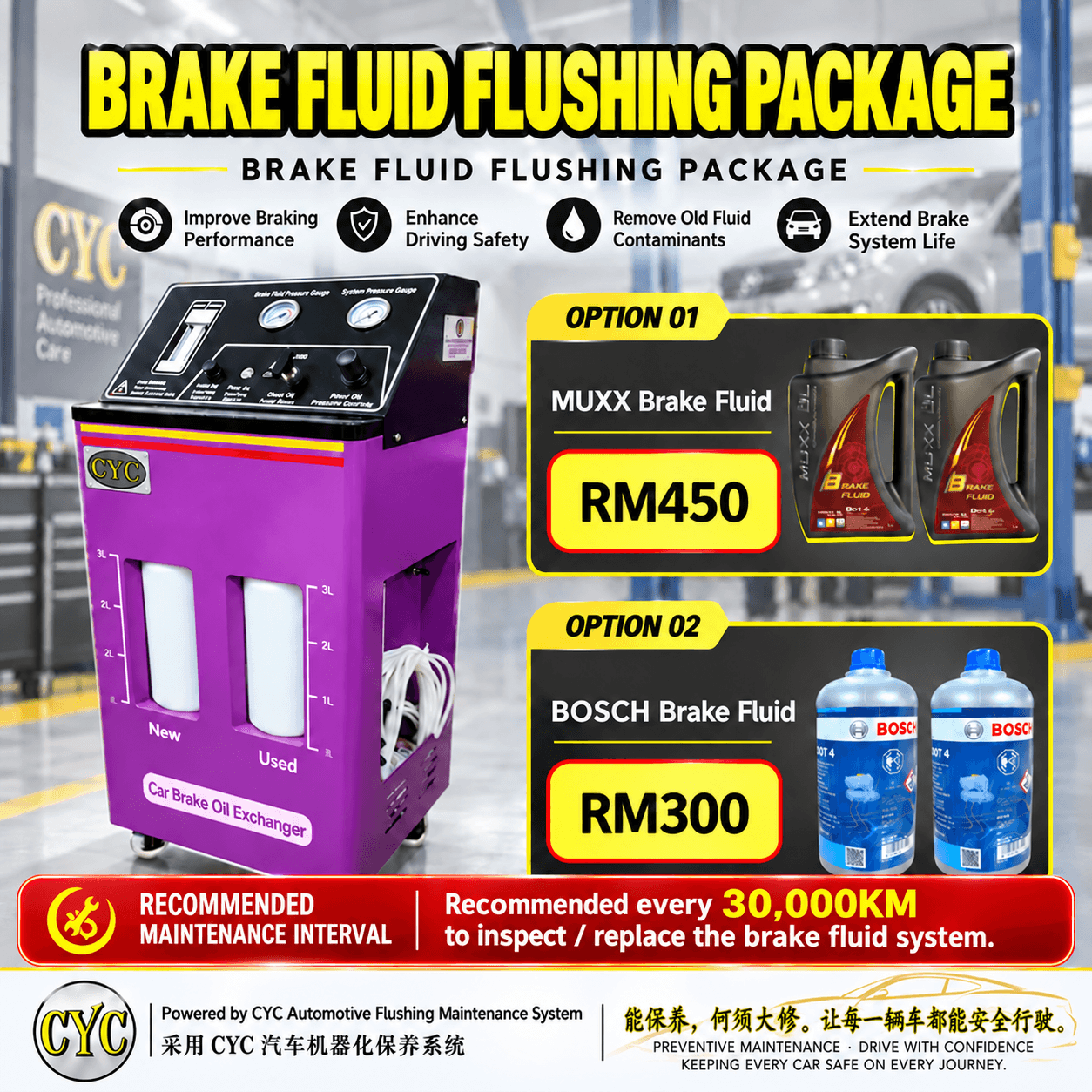
Brake Fluid Flushing Package Prices
OPTION 01 | MUXX Brake Fluid
RM450
MUXX Brake Fluid — 1L × 2 Bottles = 2L
OPTION 02 | BOSCH Brake Fluid
RM300
BOSCH Brake Fluid — 1L × 2 Bottles = 2L
Both Packages Include:
Brake Fluid Machine Flushing — Professional controlled-pressure brake fluid replacement
New Brake Fluid (2L) — Fresh brake fluid (1L × 2 bottles)
Simultaneous Four-Wheel Flushing — Simultaneous replacement through all four wheel brake circuits
Old Brake Fluid Collection — Machine-assisted old fluid recovery
Brake Bleeding & System Check — Brake bleeding and system inspection
Labour — Professional machine operation and service labour
Important Notes
Both MUXX and BOSCH packages include 2L of fresh brake fluid.
Brake fluid specifications must meet the vehicle manufacturer’s required DOT classification and applicable technical standards.
Actual charges may vary depending on the vehicle model, additional brake fluid requirements, or special bleeding procedures.
Certain ABS, ESC, Hybrid, and electronically controlled braking systems may require special diagnostic or bleeding procedures.
If brake fluid leaks, damaged components, or other braking system abnormalities are discovered, additional repairs may be recommended.
Any additional parts, repairs, or service charges will be explained and quoted for customer approval before proceeding.
⏱️ Estimated Service Time: Approximately 1 hour or more
📅 Advance appointments are recommended.
How Often Should Brake Fluid Be Inspected or Replaced?
CYC recommends inspecting brake fluid condition every 30,000 KM and determining replacement requirements based on inspection results and the vehicle manufacturer’s recommendations.
Brake fluid service life depends not only on mileage but also on age, environmental humidity, driving conditions, and the overall condition of the braking system.
Even vehicles with low mileage may experience gradual moisture absorption in their brake fluid.
CYC Recommends Checking:
Brake fluid moisture content and boiling point condition
Brake fluid contamination
Brake master cylinder, calipers, and hydraulic lines for leaks
Brake pedal feel and braking system operation
Brake pad and brake disc wear
Inspect first, then determine whether brake fluid replacement is necessary based on the vehicle’s actual condition and manufacturer requirements.
Frequently Asked Questions (FAQ)
Q1: My brake fluid looks clean. Does it still need replacing?
Possibly.
Brake fluid may appear clear while having absorbed moisture that reduces its boiling point.
Visual appearance alone is not sufficient to determine brake fluid condition.
Professional testing, service history, and manufacturer-recommended replacement intervals should be considered.
Q2: What is the difference between machine flushing and conventional brake fluid replacement?
Both methods can properly replace brake fluid when performed correctly.
CYC uses a professional machine that continuously supplies fresh brake fluid while simultaneously discharging old fluid from all four wheel brake circuits.
The controlled-pressure process provides continuous fluid supply, simultaneous flushing, and machine-assisted old fluid collection, helping improve replacement efficiency and minimize residual old fluid.
Q3: Can machine flushing remove moisture and air from the brake system?
Machine flushing helps reduce moisture content by replacing old brake fluid that has absorbed moisture.
When combined with proper bleeding procedures, it can also help remove trapped air from the brake lines.
However, certain ABS or electronically controlled braking systems require additional manufacturer-specific procedures.
Machine flushing alone cannot guarantee the complete removal of all old fluid or trapped air from every hydraulic circuit.
Q4: Must brake fluid be replaced every 30,000 KM?
Not necessarily.
30,000 KM is CYC’s recommended inspection interval, not a universal replacement requirement.
Actual replacement intervals should follow the vehicle manufacturer’s specifications and consider brake fluid age and condition.
Q5: Is machine brake fluid flushing suitable for every vehicle?
Not every vehicle is compatible with the same flushing procedure.
Some vehicles equipped with advanced ABS, electronically controlled braking systems, or Hybrid braking technology may require specialized diagnostic equipment and bleeding procedures.
Please provide your vehicle model, manufacturing year, and current mileage so CYC can confirm the appropriate service.
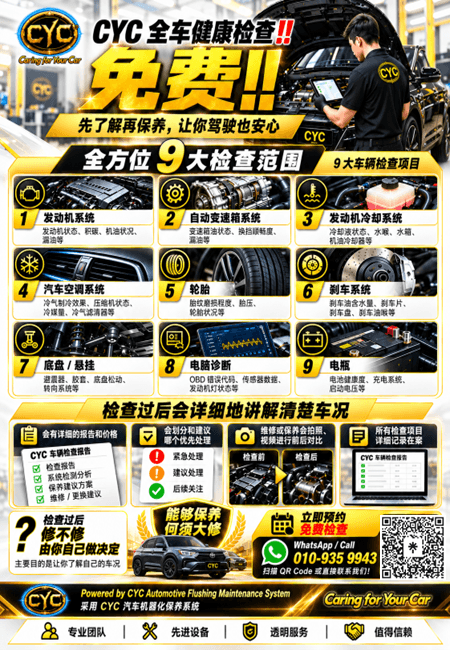
Free Comprehensive Vehicle Inspection
Inspect First, Recommend Accordingly. Understand Your Vehicle’s Condition Before Deciding on Maintenance or Repairs.
CYC provides a free comprehensive vehicle inspection covering nine major areas:
Engine System Inspection
Automatic Transmission & ATF Condition Inspection
Engine Cooling System Inspection
Automotive Air Conditioning System Inspection
Tyre Inspection
Brake System Inspection
Suspension & Undercarriage Inspection
Computerised Vehicle Diagnostics
Battery & Charging System Inspection
After the inspection, our team will explain the findings and provide maintenance recommendations with transparent pricing.
Customers can then decide whether to proceed with any recommended services.
Estimated Inspection Time: Approximately 1 hour, depending on vehicle condition.
Watch Our Vehicle Inspection Video
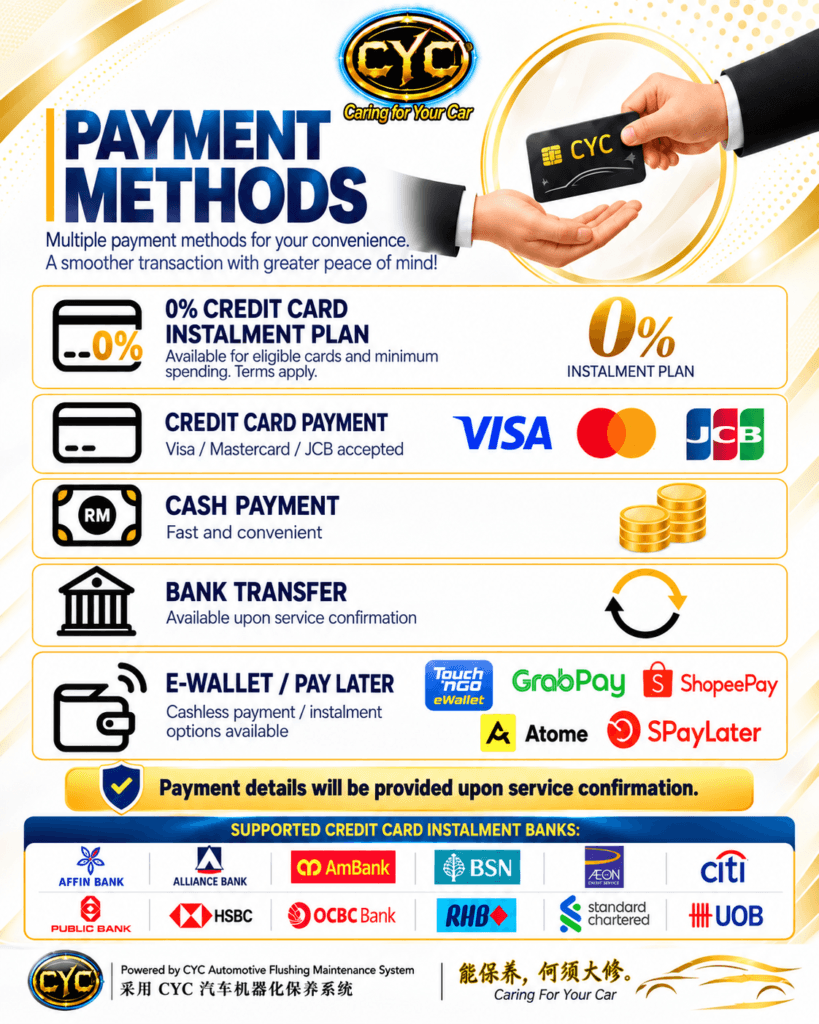
Flexible Payment Options
CYC offers several convenient payment methods to help customers manage their vehicle maintenance expenses.
0% Credit Card Instalment Plans: Eligible transactions of RM500 and above may qualify for 6- or 12-month instalment plans.
Standard Credit Card Payment
Shopee / Grab PayLater (subject to applicable terms)
ShopeePay / GrabPay / Touch ‘n Go eWallet
Cash and Bank Transfer
Instalment facilities are subject to the applicable payment provider’s terms and CYC’s eligibility conditions.