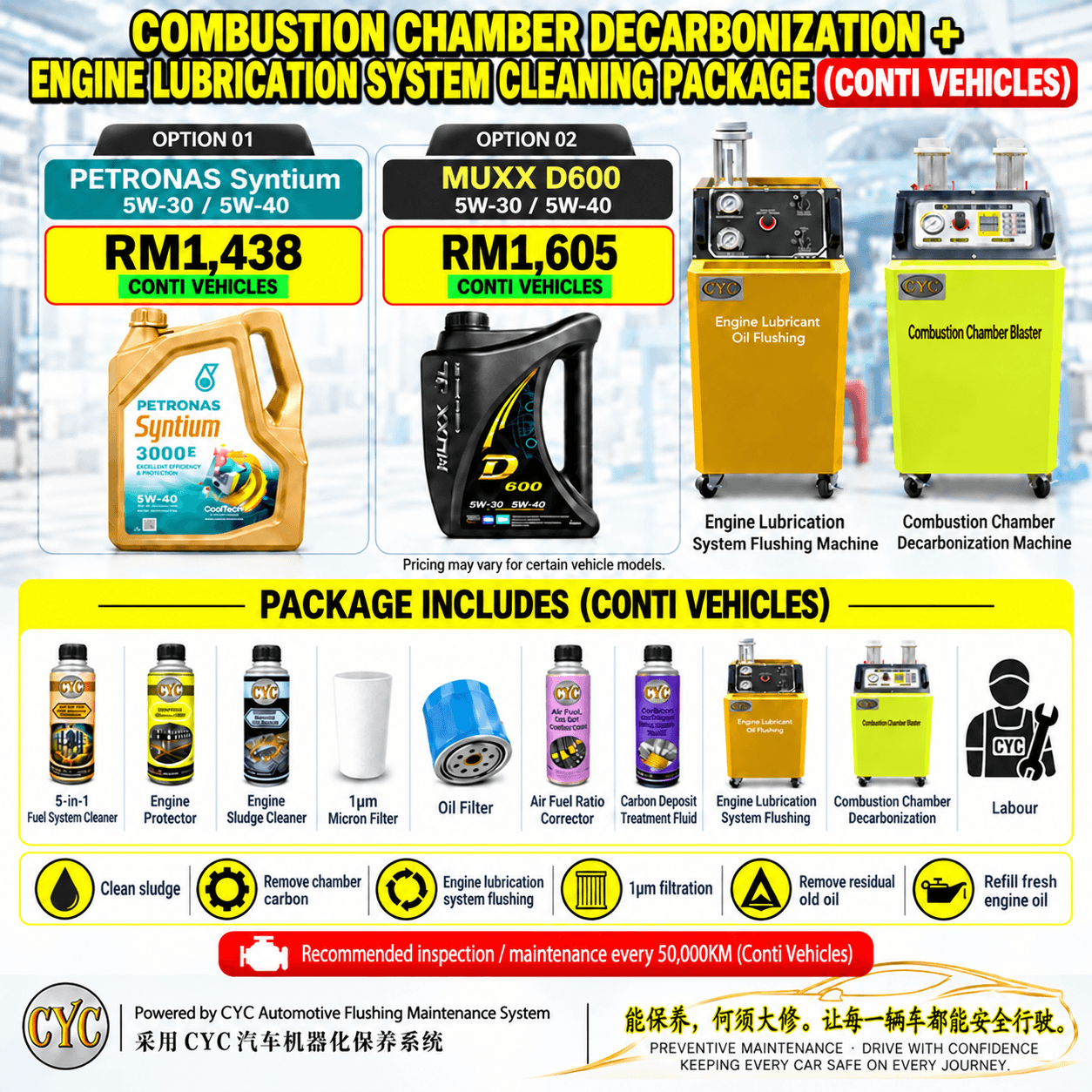
Professional Carbon Cleaning · Engine Oil Flushing · Complete Preventive Maintenance
Why Is Engine Oil Flushing and an Oil Change Necessary After Combustion Chamber Carbon Cleaning?
Because cleaning the combustion chamber does not mean the entire cleaning process is complete.
Over time, carbon deposits may gradually accumulate inside the engine’s combustion chamber and on the piston crown. Excessive carbon buildup can affect combustion efficiency and overall engine performance.
Professional combustion chamber cleaning helps soften, loosen, and remove these carbon deposits.
However, during the cleaning process, some cleaning fluid and loosened carbon contaminants may pass through the small clearances between the piston rings and cylinder walls, entering the crankcase and mixing with the engine oil.
Some contaminants may also remain in the engine lubrication system and oil pan.
That is why CYC focuses not only on removing combustion chamber carbon deposits but also on proper lubrication system maintenance after cleaning.
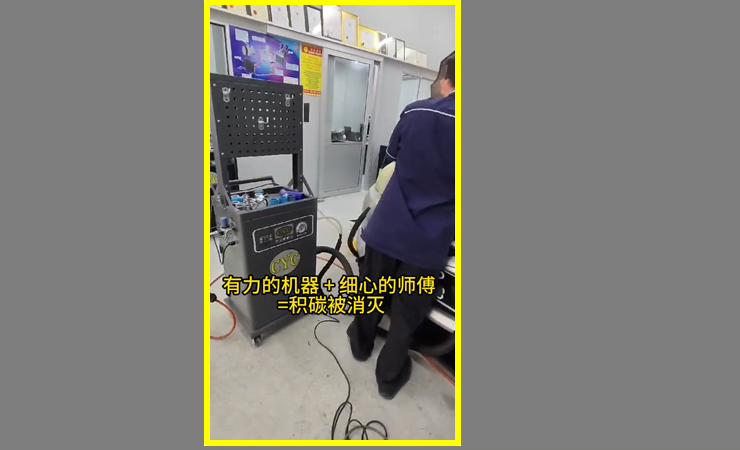
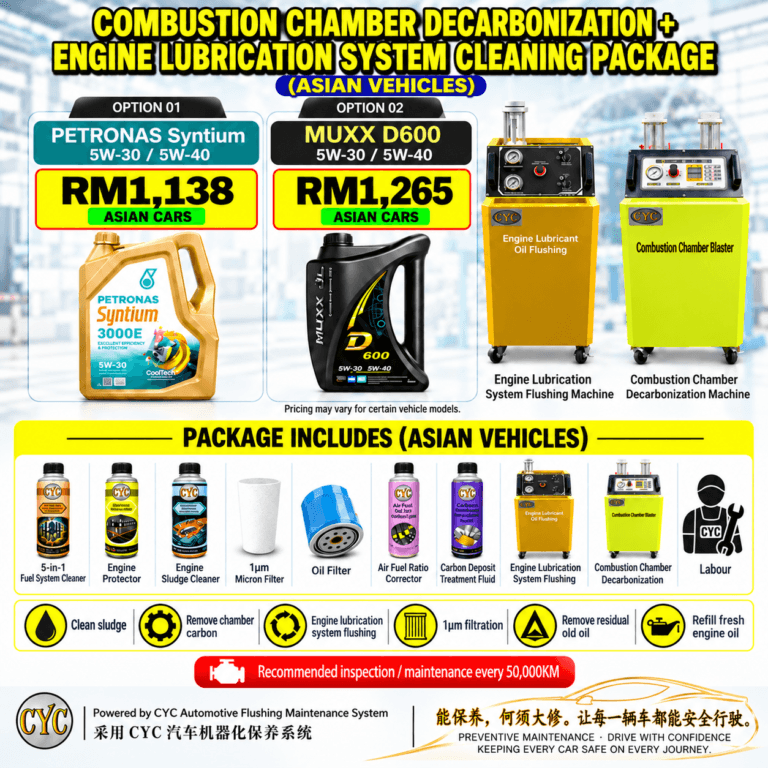
CYC uses two professional machines as part of a complete maintenance procedure:
Combustion Chamber Decarbonization → Engine Lubrication System Flushing → 1-Micron Precision Filtration → Residual Old Oil Removal → Fresh Engine Oil & Oil Filter Replacement
For vehicles equipped with a steel oil pan, CYC’s service procedure also requires oil pan removal and internal cleaning to address possible accumulated sludge and deposits.
We don’t just clean carbon deposits. We also take care of what happens afterward.
01 | Where Do Carbon Deposits Build Up?
Understanding Combustion Chamber Carbon Deposits
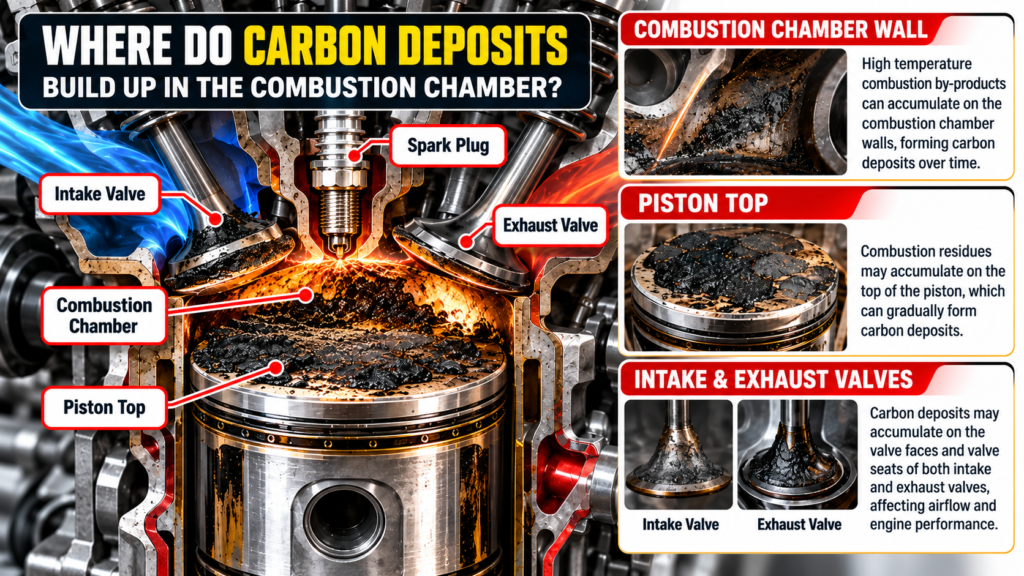
The combustion chamber is where the air-fuel mixture burns to generate the force that drives the piston.
As the engine operates over time, combustion by-products may accumulate on the combustion chamber surfaces and piston crown, forming carbon deposits.
Excessive carbon buildup may contribute to:
Unstable engine idling
Sluggish throttle response
Reduced engine performance
Increased fuel consumption
Rough or less responsive engine operation
These symptoms may also result from ignition, fuel injection, sensor, or mechanical problems. Proper inspection is necessary to identify the actual cause.
How Does CYC Clean Combustion Chamber Carbon Deposits?
CYC uses a professional Combustion Chamber Blaster, together with Carbon Deposit Treatment Fluid, to help soften and loosen carbon deposits before performing the cleaning procedure.
The service primarily targets:
Carbon deposits inside the combustion chamber
Carbon buildup on the piston crown
Other accessible carbon deposits within the treated combustion chamber area
When carbon buildup contributes to engine performance problems, appropriate cleaning may help improve combustion conditions and engine operation.
The purpose of combustion chamber decarbonization is to reduce accumulated deposits and maintain a cleaner combustion environment.
Actual cleaning results depend on carbon buildup, engine design, and mechanical condition. Combustion chamber cleaning cannot repair worn or damaged engine components.
02 | What Happens to Cleaning Fluid and Carbon Residues After Decarbonization?
Understanding How Cleaning Residues May Enter the Engine Oil
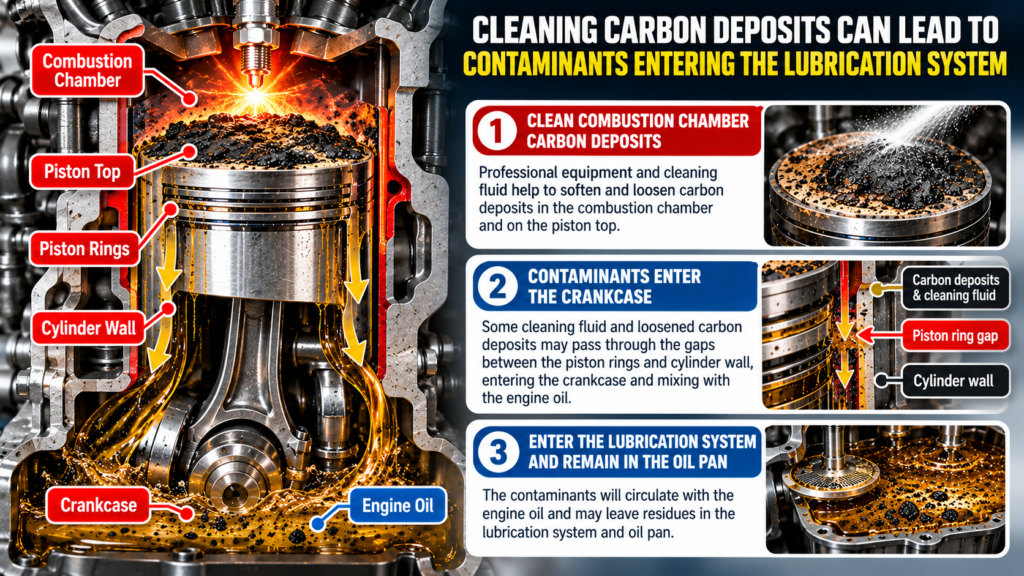
This is an important part of combustion chamber cleaning that many vehicle owners overlook.
Although the combustion chamber and engine lubrication system perform different functions, they are not completely isolated from one another.
As the piston moves inside the cylinder, the piston rings help seal the combustion chamber and control engine oil.
Because small operating clearances exist between the piston rings and cylinder walls, some cleaning fluid and loosened carbon contaminants may pass into the crankcase during combustion chamber cleaning.
These contaminants may mix with the existing engine oil, increasing oil contamination and potentially leaving residues in the oil pan and other areas.
Why Shouldn’t the Service End After Combustion Chamber Cleaning?
If cleaning residues enter the engine oil and are not properly addressed, contaminated oil may remain in the lubrication system.
A complete combustion chamber cleaning service should not focus only on how clean the piston crown looks. It should also consider how cleaning residues are handled afterward.
For this reason, CYC includes engine lubrication system flushing and a fresh engine oil change as part of its complete combustion chamber decarbonization package.
03 | Why Does CYC Perform Engine Lubrication System Flushing After Carbon Cleaning?
The Importance of Proper Post-Decarbonization Maintenance
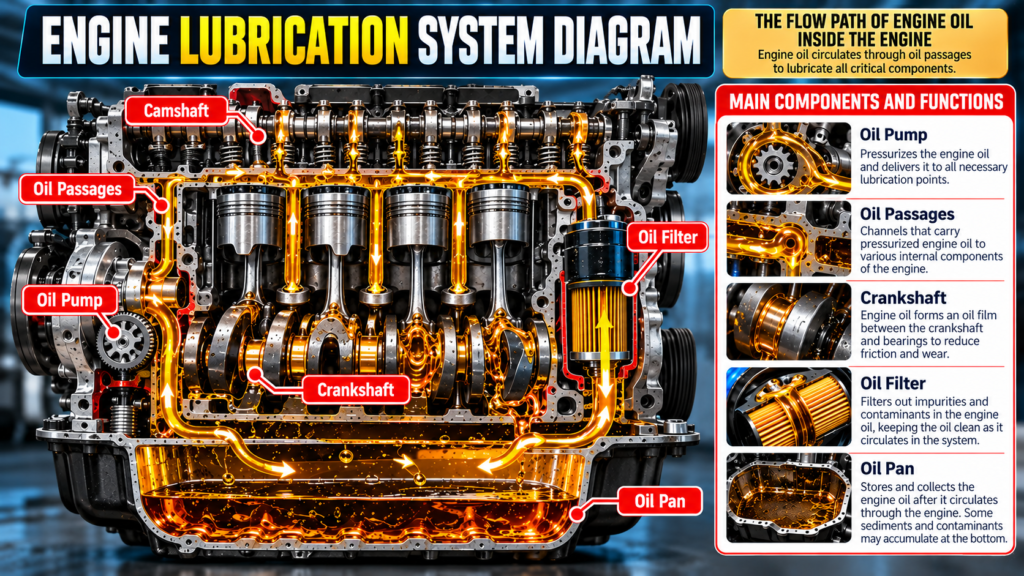
The engine lubrication system circulates oil to components requiring lubrication, including the crankshaft and other internal moving parts.
After combustion chamber cleaning, some cleaning residues may mix with the engine oil and enter the crankcase.
CYC therefore uses a professional Engine Lubricant Oil Flushing Machine to carry out the next stage of maintenance.
CYC’s Engine Lubrication System Cleaning Process
1. Machine-Assisted Circulation Cleaning
The flushing machine connects to the engine oil filter housing or mounting point using dedicated adapters.
The engine’s original oil pump drives oil circulation through the connected cleaning system, helping remove sludge and suspended contaminants.
2. 1-Micron Precision Filtration
A 1μm Micron Filter helps capture fine contaminants circulating through the flushing system.
3. Further Removal of Residual Old Oil
After flushing, additional steps are taken to drain residual old engine oil, helping reduce the amount of contaminated oil remaining in the system.
4. Fresh Engine Oil and Oil Filter Replacement
Once the cleaning process is completed, fresh engine oil meeting the vehicle’s required specifications is added, and a new engine oil filter is installed.
Why Not Simply Drain and Replace the Engine Oil?
A conventional engine oil change primarily drains old oil from the oil pan.
However, some old oil and contaminants may remain inside engine oil passages and other internal areas.
CYC’s machine-assisted circulation cleaning and precision filtration are designed to provide additional cleaning before fresh engine oil is introduced.
Combustion chamber cleaning addresses carbon deposits. Lubrication system flushing and an oil change complete the post-cleaning maintenance process.
Machine flushing helps reduce contaminants but cannot guarantee complete removal of every residue inside an engine.
04 | Why Must a Steel Oil Pan Be Removed and Cleaned?
Steel Oil Pan Removal & Cleaning
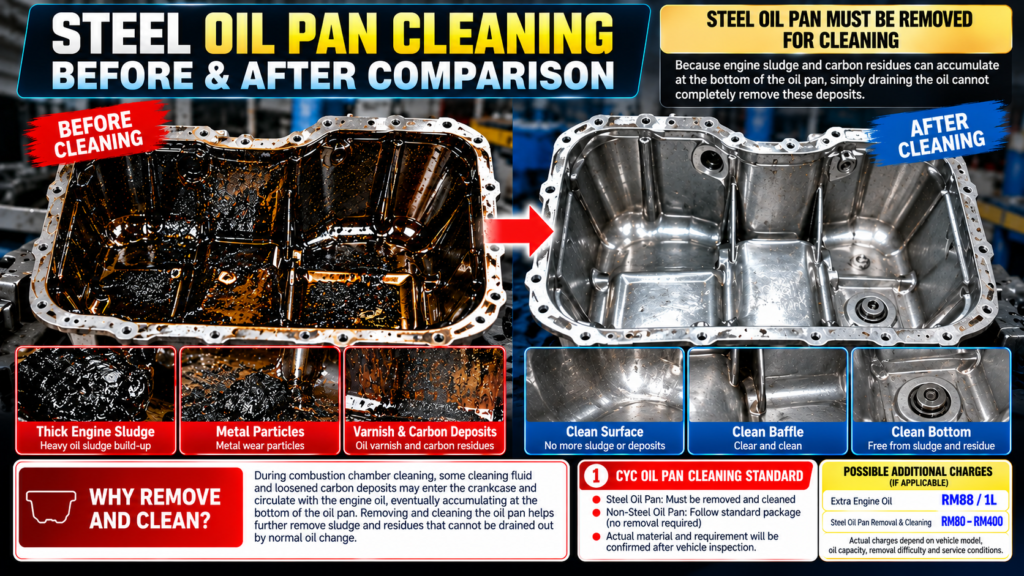
The Oil Pan Is Another Area Where Contaminants May Accumulate
The engine oil pan is located at the bottom of the engine and collects oil returning from the lubrication system.
Over time, sludge and deposits may accumulate on its internal surfaces.
During combustion chamber cleaning, some cleaning fluid and loosened carbon contaminants may enter the crankcase, mix with engine oil, and potentially leave residues in the oil pan.
Simply draining the engine oil may not adequately remove deposits attached to the bottom of the oil pan.
CYC therefore applies different service procedures depending on the oil pan material.
CYC Oil Pan Cleaning Standard
Steel Oil Pan
Under CYC’s service procedure, a steel oil pan must be removed and cleaned internally.
This helps address sludge and contaminants that may remain attached to the bottom of the oil pan after conventional oil draining.
Non-Steel Oil Pan
Under CYC’s current standard package procedure, additional oil pan removal and cleaning are not required.
The actual oil pan material, construction, and applicable cleaning procedure will be confirmed during vehicle inspection.
Possible Additional Charges
Service | Price |
|---|---|
| Extra Engine Oil | RM88 / 1L |
| Steel Oil Pan Removal & Cleaning | RM80–RM400 |
Actual charges depend on the vehicle model, required engine oil quantity, accessibility, and labour involved. Any additional work and charges will be explained and quoted before proceeding.
05 | Why Does CYC Use Two Different Cleaning Machines?
Two Professional Machines · One Complete Maintenance Process
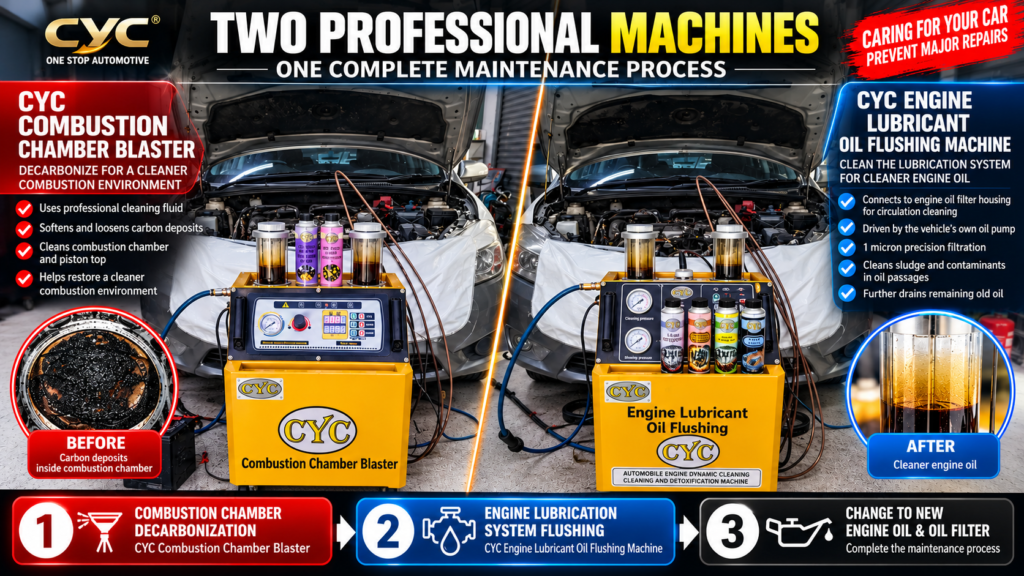
Machine 01 | Combustion Chamber Blaster
Professional Combustion Chamber Carbon Cleaning
This machine is used to clean carbon deposits inside the combustion chamber and on the piston crown.
Machine 02 | Engine Lubricant Oil Flushing Machine
Professional Engine Lubrication System Cleaning
After combustion chamber decarbonization, this machine performs circulation cleaning and precision filtration to help address engine sludge and contaminants that may have mixed with the engine oil.
Final Stage | Fresh Engine Oil & Oil Filter Replacement
After the cleaning procedures, residual oil removal, and any applicable oil pan cleaning, the engine receives fresh engine oil and a new oil filter.
The two machines serve different purposes but work together as part of one complete combustion chamber cleaning and engine lubrication maintenance process.
06 | CYC Combustion Chamber Decarbonization Package Prices
European Vehicles
OPTION 01 | PETRONAS Syntium
RM1,438
Engine Oil: 5W-30 / 5W-40
OPTION 02 | MUXX D600
RM1,605
Engine Oil: 5W-30 / 5W-40
Both Packages Include
Combustion Chamber Decarbonization + Engine Lubrication System Machine Flushing + 1-Micron Precision Filtration + Fresh Engine Oil & Oil Filter Replacement
Important Pricing Information
The prices above apply to eligible European vehicles that meet the standard package requirements. They are not fixed prices for every European vehicle.
Additional assessment or a customised quotation may be required for:
6-cylinder engines
V6 engines
V8 engines
Other multi-cylinder or specialised engine configurations
Vehicles requiring additional engine oil
Vehicles requiring special adapters or additional dismantling work
Vehicles requiring steel oil pan removal and cleaning
For 6-cylinder, V6, V8, and other special engine configurations, please contact CYC to confirm the applicable package and quotation.
Engine oil viscosity and specifications must meet the vehicle manufacturer’s requirements. The availability of 5W-30 or 5W-40 does not automatically mean either grade is suitable for every European engine.
07 | What’s Included in the Dual-System Cleaning Package?
Package Includes
Package Item | Description |
|---|---|
| Engine Oil | PETRONAS Syntium or MUXX D600 |
| Engine Oil Filter | New engine oil filter |
| Engine Sludge Cleaner | Engine lubrication system cleaning additive |
| Engine Protector | Engine protection additive |
| 5-in-1 Fuel System Cleaner | Fuel system cleaning additive |
| 1μm Micron Filter | 1-micron precision filtration |
| Air Fuel Ratio Corrector | Air-fuel ratio treatment additive |
| Carbon Deposit Treatment Fluid | Combustion chamber carbon treatment fluid |
| Engine Lubricant Oil Flushing | Professional machine-assisted lubrication system cleaning |
| Combustion Chamber Decarbonization | Professional machine-assisted combustion chamber carbon cleaning |
| Professional Labour Service | Professional service and cleaning procedures |
Additional engine oil, steel oil pan removal and cleaning, and special vehicle-related labour or service charges are not included in the standard package price.
08 | Before & After Cleaning Results and Transparent Service Records
Real Cleaning Results · Transparent Service Documentation
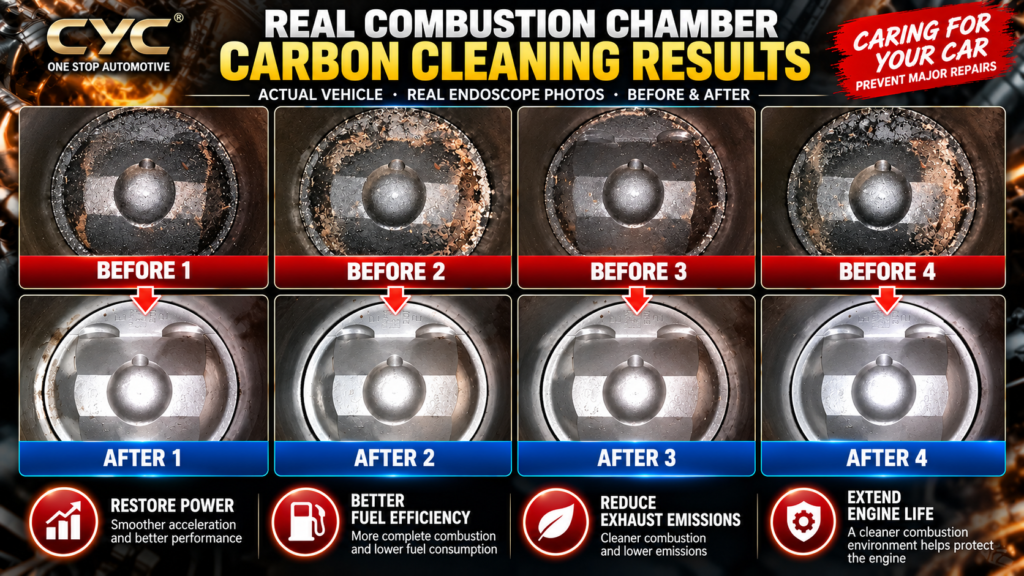
See the Cleaning Results
CYC believes vehicle owners should understand what has been done to their vehicles.
For applicable cleaning services, we provide relevant Before & After photographs to show the visible condition of carbon deposits, sludge, or other accumulated contaminants before and after cleaning.
These images help vehicle owners better understand the cleaning procedure and its visible results.
Repair Work Is Documented Too
When a vehicle also requires repair work or component replacement, CYC provides relevant before-and-after service records where applicable.
This helps customers understand the work performed and the components addressed.
Vehicle Inspection · Clear Explanation · Transparent Quotation · Service Documentation
Know What Was Done. See the Results. Maintain With Confidence.
Photographs depend on the services performed and the accessibility of the relevant components. Visible cleaning results do not guarantee mechanical performance improvements or long-term engine reliability.
09 | How Often Should This Maintenance Be Performed?
Combustion Chamber Decarbonization + Engine Lubrication System Cleaning
Recommended inspection and maintenance assessment every 50,000 KM.
CYC recommends checking combustion chamber carbon buildup approximately every 50,000 KM and performing cleaning when appropriate, based on the vehicle’s actual condition.
Standalone Engine Sludge Cleaning
Recommended every 10,000 KM or during a regular engine oil change, where suitable.
For vehicles in suitable mechanical condition, engine lubrication system cleaning may be incorporated into a regular engine oil maintenance programme.
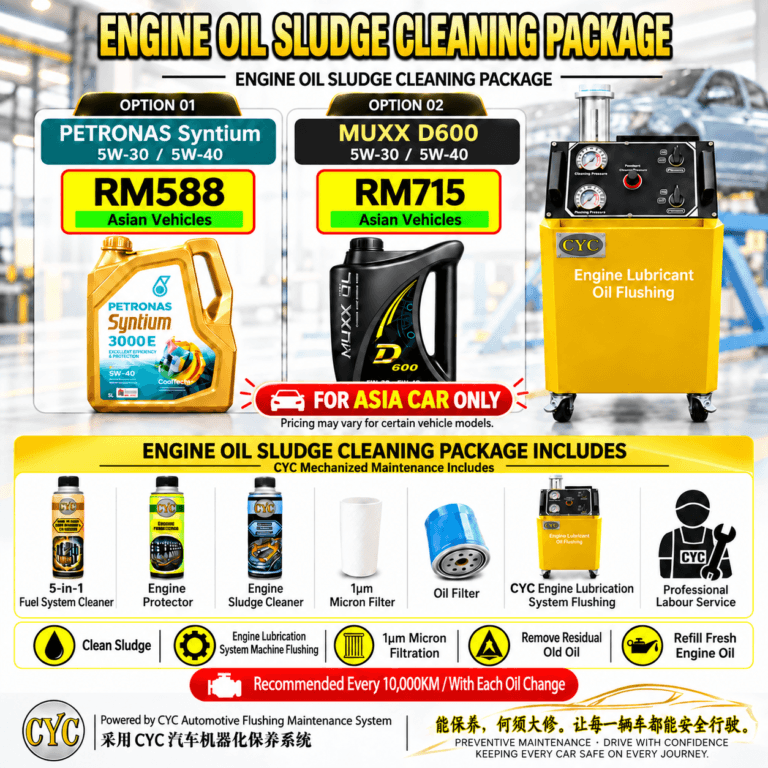
Engine sludge cleaning can be performed as a standalone service. CYC’s combustion chamber decarbonization package includes the subsequent lubrication system cleaning and engine oil replacement.
These intervals are CYC’s preventive maintenance recommendations and are not universal vehicle manufacturer requirements.
10 | Frequently Asked Questions (FAQ)
Q1. Why Is Engine Oil Flushing Necessary After Combustion Chamber Carbon Cleaning?
During combustion chamber cleaning, some cleaning fluid and loosened carbon contaminants may pass through the clearances between the piston rings and cylinder walls into the crankcase, where they can mix with the engine oil.
CYC therefore follows combustion chamber cleaning with machine-assisted lubrication system flushing, precision filtration, old oil removal, and fresh engine oil and filter replacement.
We don’t just remove carbon deposits. We also complete the necessary post-cleaning maintenance.
Q2. Why Does CYC Use Two Different Machines?
Because combustion chamber cleaning and engine lubrication system cleaning serve different purposes.
The first machine cleans carbon deposits inside the combustion chamber and on the piston crown.
The second machine performs lubrication system flushing and precision filtration to help address sludge and possible cleaning residues.
Both machines are used in sequence as part of CYC’s complete cleaning and maintenance process.
Q3. Why Must the Engine Oil Be Replaced After Carbon Cleaning?
Some cleaning fluid and loosened carbon contaminants may enter the crankcase and mix with the existing engine oil.
Without appropriate post-cleaning maintenance, contaminated oil may remain in the lubrication system.
CYC therefore performs lubrication system cleaning, drains the old oil, and replaces it with fresh engine oil and a new oil filter.
Q4. Why Must a Steel Oil Pan Be Removed and Cleaned?
Sludge and contaminants may accumulate at the bottom of the oil pan, where conventional oil draining may not adequately remove deposits attached to internal surfaces.
Under CYC’s service standard, steel oil pans must be removed and cleaned internally.
The oil pan material, applicable procedure, and additional charges will be confirmed during vehicle inspection.
Q5. Can Combustion Chamber Carbon Cleaning Improve Fuel Consumption, Rough Idling, or Poor Acceleration?
If carbon buildup is a contributing cause, appropriate cleaning may help improve engine operation.
However, these symptoms can also result from ignition problems, fuel injection issues, faulty sensors, or mechanical wear.
A proper vehicle inspection is necessary before determining the appropriate service.
Q6. Can This Package Fix an Engine That Is Burning Oil?
This package primarily addresses combustion chamber carbon deposits and engine lubrication system sludge.
It is not a dedicated repair solution for excessive engine oil consumption.
If a vehicle is experiencing significant oil consumption, further inspection may be required to assess the piston rings, valve stem seals, and other possible causes.
CYC also offers a separate non-dismantling oil-burning treatment service for suitable cases, subject to vehicle assessment.
Q7. Do I Need Both Cleaning Services Every Time I Change My Engine Oil?
No. Combustion chamber decarbonization is not necessary at every engine oil change.
Engine Sludge Cleaning: CYC recommends approximately every 10,000 KM or during a regular oil change for suitable vehicles.
Combustion Chamber Decarbonization: CYC recommends inspection approximately every 50,000 KM, with cleaning performed according to the actual carbon buildup.
However, when performing CYC’s combustion chamber decarbonization package, the subsequent lubrication system cleaning and engine oil replacement are included in the service procedure.
Q8. Are RM1,438 and RM1,605 Fixed Prices for All European Vehicles?
No.
The standard package prices apply only to eligible European vehicles.
6-cylinder, V6, V8, and other specialised engine configurations require quotation confirmation.
Additional engine oil, special adapters, and steel oil pan removal and cleaning may also involve additional charges.
Please provide your vehicle make, model, year, engine capacity, and current mileage so CYC can confirm the applicable service and quotation.
Q9. Can I See the Actual Cleaning Results?
Yes.
For applicable cleaning services, CYC provides relevant before-and-after photographs showing visible cleaning results.
If repair work is also performed, relevant before-and-after service records will be provided where applicable.
We want customers to understand the work performed and see the documented results.
11 | Free Comprehensive Vehicle Inspection
Inspect First. Recommend Based on Actual Condition.
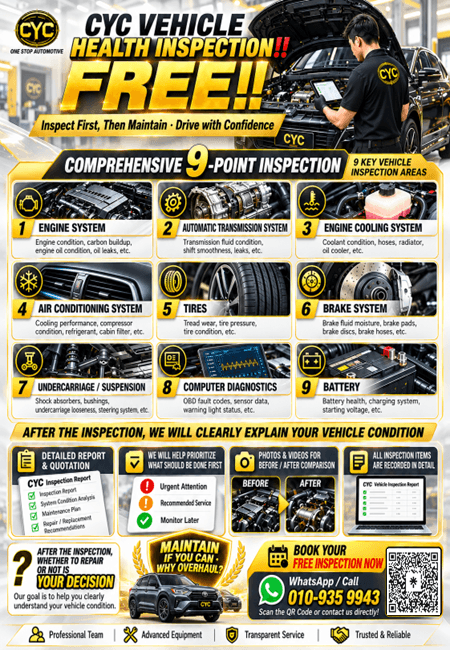
CYC offers a free comprehensive vehicle inspection covering nine major automotive systems:
Engine System Inspection
Automatic Transmission & ATF Condition Inspection
Engine Cooling System Inspection
Air Conditioning System Inspection
Tyre Inspection
Brake System Inspection
Chassis & Suspension System Inspection
Computerised Vehicle Diagnostics
Battery & Charging System Inspection
After the inspection, our team will explain the findings, provide suitable maintenance recommendations, and present a transparent quotation.
Customers can then decide whether to proceed with the recommended services.
Estimated Inspection Time: Approximately 1 hour, depending on vehicle condition.
12 | Flexible Payment Options
CYC offers several convenient payment methods:
0% Credit Card Instalment: Eligible transactions of RM500 and above may qualify for 6-month or 12-month instalment plans.
Credit Card Payment
Shopee / Grab PayLater (subject to eligibility and applicable terms)
ShopeePay
GrabPay
Touch ‘n Go eWallet
Cash
Bank Transfer
Instalment and PayLater arrangements are subject to the applicable payment provider’s conditions and CYC’s service terms.

13 | Book Your Combustion Chamber Decarbonization Package
How many kilometres has your vehicle travelled? Have you checked its combustion chamber carbon buildup?
If you would like to know whether your European vehicle is suitable for combustion chamber decarbonization and engine lubrication system cleaning, contact CYC for an assessment.
Please provide the following information:
Vehicle Make & Model
Year of Manufacture
Engine Capacity (CC)
Current Mileage (KM)
Petrol / Diesel / Hybrid
Any symptoms such as reduced power, rough idling, increased fuel consumption, or other engine abnormalities
Our team will review your vehicle information and confirm the appropriate cleaning method, package eligibility, and quotation.
WhatsApp: +60 10-935 9943
CYC ONE STOP AUTOMOTIVE SDN. BHD.
Preventive Maintenance · Drive With Confidence · Keeping Every Car Safe on Every Journey.
Caring For Your Car.