Rough Idling, Reduced Engine Power or Increased Fuel Consumption? Your Fuel Injectors Could Be the Cause!
Over time, fuel injectors may gradually accumulate fuel deposits, carbon residue, and other contaminants inside the injectors and around their nozzles.
Fuel injectors play an important role in delivering the correct amount of fuel into the engine with the appropriate spray pattern and atomization.
When fuel injectors become contaminated or partially blocked, fuel delivery, spray uniformity, and atomization may be affected, potentially reducing combustion efficiency and engine performance.
Common Symptoms Include:
Rough Idling: Engine vibration or unstable idling when the vehicle is stationary.
Reduced Engine Power: Sluggish acceleration or a noticeable decrease in engine performance.
Increased Fuel Consumption: Abnormal fuel injection may affect combustion efficiency and increase fuel consumption.
Uneven Acceleration: Hesitation, jerking, or inconsistent power delivery during acceleration.
Engine Misfires: Severe injector problems may contribute to misfires in one or more cylinders.
Important: These symptoms are not necessarily caused by fuel injectors. Ignition system faults, abnormal fuel pressure, intake system issues, or other engine problems may cause similar symptoms. A proper inspection is recommended before deciding whether injector cleaning is necessary.
What Is Fuel Injector Ultrasonic Cleaning & Testing?
Fuel Injector Ultrasonic Cleaning & Testing is a professional service designed to clean fuel injectors and evaluate their operating performance.
CYC uses a specialised Fuel Injector Ultrasonic Cleaning & Testing Machine to help remove fuel deposits, dirt, and contaminants from suitable fuel injectors using ultrasonic cleaning technology.
Unlike simply adding a fuel system cleaner to the fuel tank, off-car injector cleaning allows compatible fuel injectors to be individually cleaned, inspected, and tested using professional equipment.
CYC’s Service Goes Beyond Cleaning and Includes:
01 | Ultrasonic Cleaning
Uses high-frequency ultrasonic vibrations to create cavitation in a cleaning solution, helping remove dirt and deposits from accessible injector components and passages.
02 | Fuel Injector Flow Testing
Measures and compares the amount of fuel delivered by individual injectors under the same testing conditions to identify significant differences in flow rates.
03 | Spray Pattern Testing
Examines injector spray patterns, fuel distribution, and atomization characteristics to identify irregular or uneven spray performance.
04 | Cleaning Performance Assessment
Where supported by the equipment and injector type, injector performance can be compared before and after cleaning to evaluate whether improvements have been achieved.
Important: Cleaning may help remove certain contaminants, but it cannot repair internal mechanical wear, injector coil failures, or other electrical and mechanical damage.
Benefits of Fuel Injector Ultrasonic Cleaning & Testing
01 | Helps Restore Proper Fuel Injection
Removes certain deposits and contaminants that may interfere with fuel delivery, helping improve injector performance affected by contamination.
02 | Improves Fuel Atomization
When injector nozzles are affected by deposits, professional cleaning may help improve spray patterns and fuel atomization.
03 | Supports Smoother Engine Operation
If rough idling or unstable engine operation is caused by contaminated fuel injectors, cleaning may help improve these symptoms.
04 | Helps Restore Fuel Efficiency
When abnormal fuel injection affects combustion, appropriate cleaning may help improve combustion performance and fuel consumption.
05 | Helps Avoid Unnecessary Parts Replacement
Professional testing helps determine whether injector performance can be improved through cleaning or whether further repairs or replacement may be necessary.
A dirty fuel injector does not always need to be replaced. However, a cleaned injector does not necessarily mean it is functioning correctly. The key is evaluating its performance through testing.
Frequently Asked Questions (FAQ)
Q1: Do dirty fuel injectors always need to be replaced?
Not necessarily. It is important to determine whether the problem is caused by contamination or actual component failure.
If the injectors are affected by fuel deposits, dirt, or partial blockages while their internal mechanical and electrical components remain functional, professional cleaning may help improve their performance.
However, injectors with internal wear, electrical faults, severe leakage, or other damage that cannot be corrected through cleaning may require replacement.
CYC recommends making decisions based on inspection and testing results rather than replacing injectors solely because of engine symptoms.
Q2: What is the difference between fuel injector cleaning and fuel injector testing?
Cleaning removes contaminants, while testing evaluates injector performance.
A fuel injector may appear clean externally but still have abnormal fuel delivery, an uneven spray pattern, or poor atomization.
CYC uses professional equipment to conduct suitable flow and spray pattern tests, helping evaluate injector performance after cleaning.
Cleaning is the process. Testing results provide important information for evaluating the injector’s actual operating condition.
Q3: Is adding fuel injector cleaner to the fuel tank the same as off-car ultrasonic cleaning?
No. These two methods differ in their cleaning procedures and testing capabilities.
Fuel Tank Additive Cleaning (Fuel Injector Cleaner)
Fuel injector cleaning additives are added to the fuel tank and circulate through the fuel system during engine operation.
They may help remove certain fuel system deposits, depending on the formulation and operating conditions.
Ultrasonic Cleaning & Testing
Compatible injectors are removed from the engine and cleaned using professional ultrasonic equipment.
Depending on injector design and equipment compatibility, suitable flow and spray pattern tests can also be performed.
The main difference: Fuel tank additives generally do not allow individual injector spray performance to be directly observed, while off-car testing enables compatible injectors to be evaluated individually.
Q4: Do fuel injectors need cleaning every 40,000–60,000 KM?
Not necessarily. CYC recommends evaluating fuel injector maintenance needs approximately every 40,000–60,000 KM, rather than automatically performing injector cleaning at every interval.
Injector contamination varies depending on fuel quality, engine design, driving habits, and vehicle operating conditions.
If the engine is running smoothly, fuel injection performance appears normal, and there are no related symptoms or fault indications, immediate injector removal and cleaning may not be necessary.
However, if the vehicle experiences rough idling, reduced engine power, abnormal fuel consumption, or related diagnostic trouble codes, a fuel system inspection should be performed first.
Further injector testing or cleaning can then be recommended based on the inspection findings.
Q5: Can all petrol and diesel fuel injectors be cleaned and tested using the same machine?
No. Cleaning and testing suitability depends on injector type, design, and equipment compatibility.
Different engines may use different fuel injection technologies, including:
Port Fuel Injection (PFI / MPI)
Gasoline Direct Injection (GDI)
Common Rail Diesel Injection
These systems operate at different fuel pressures and use different injector control technologies.
Therefore, not all injector types can be fully tested using the same equipment.
CYC will assess the vehicle’s fuel injection system and injector type to confirm whether the appropriate cleaning and testing service is available.
Service Pricing
Service charges may vary depending on the vehicle model, number of fuel injectors, injector design, installation location, and the complexity of dismantling and reinstallation.
The available cleaning and testing procedures may also differ depending on injector type and equipment compatibility.
To help us confirm service suitability and provide an accurate quotation, kindly provide the following vehicle information:
Vehicle Brand & Model
Year of Manufacture
Engine Capacity (CC)
Fuel Type (Petrol / Diesel / Hybrid)
Current Mileage (KM)
Our team will review your vehicle details and advise on the applicable service and pricing.
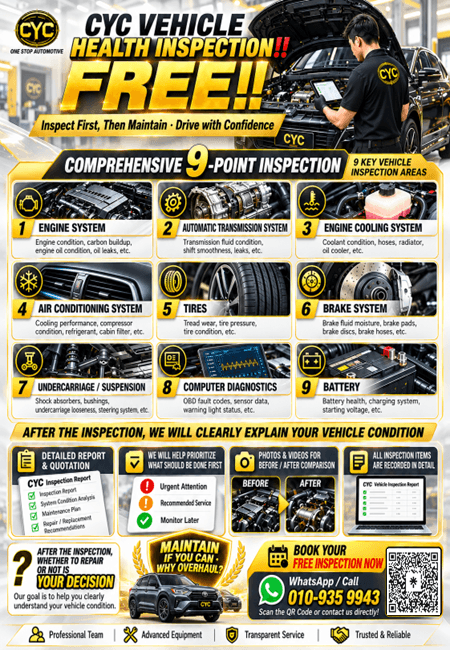
Free Comprehensive Vehicle Inspection
Inspect First, Recommend Accordingly. Understand Your Vehicle’s Condition Before Deciding on Maintenance or Repairs.
CYC provides a free comprehensive vehicle inspection covering nine major areas:
Engine System Inspection
Automatic Transmission & ATF Condition Inspection
Engine Cooling System Inspection
Automotive Air Conditioning System Inspection
Tyre Inspection
Brake System Inspection
Suspension & Undercarriage Inspection
Computerised Vehicle Diagnostics
Battery & Charging System Inspection
After the inspection, our team will explain the findings and provide maintenance recommendations with transparent pricing.
Customers can then decide whether to proceed with any recommended services.
Estimated Inspection Time: Approximately 1 hour, depending on vehicle condition.
Flexible Payment Options
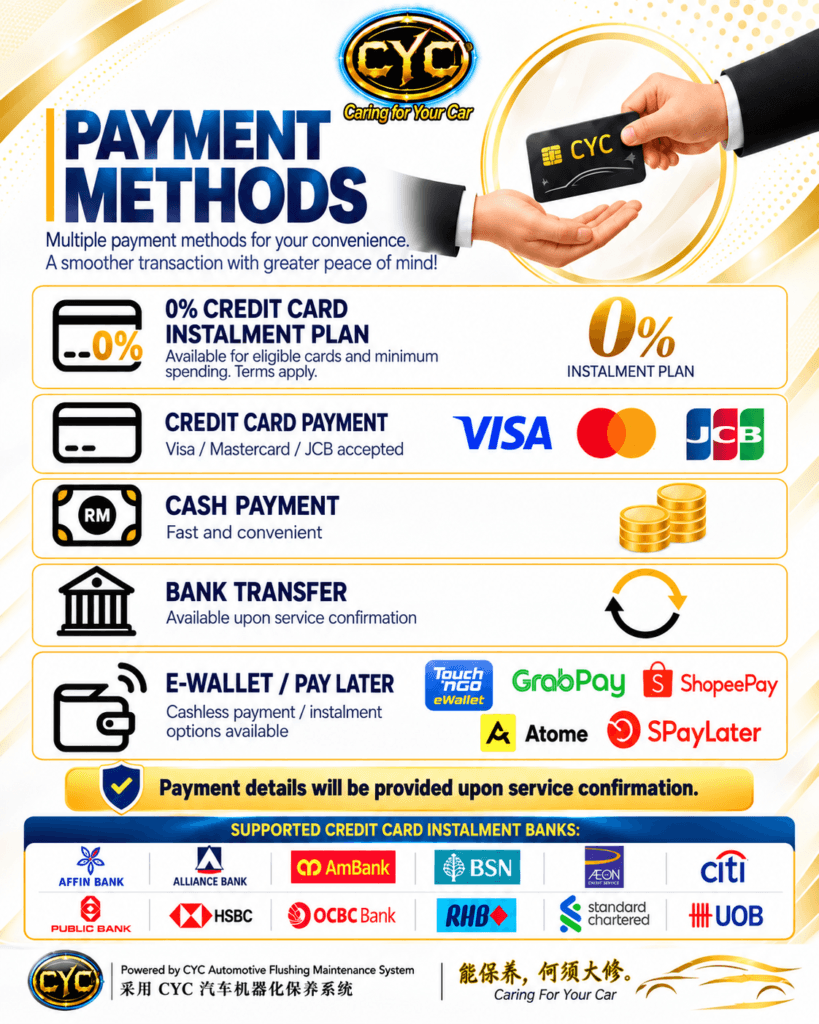
CYC offers several convenient payment methods to help customers manage their vehicle maintenance expenses.
0% Credit Card Instalment Plans: Eligible transactions of RM500 and above may qualify for 6- or 12-month instalment plans.
Standard Credit Card Payment
Shopee / Grab PayLater (subject to applicable terms)
ShopeePay / GrabPay / Touch ‘n Go eWallet
Cash and Bank Transfer
Instalment facilities are subject to the applicable payment provider’s terms and CYC’s eligibility conditions.